One frightened dog, one bitten finger and a police inspector who changes his verdict as fast as he changes his coat. In an 1884 Russian market square, justice depends less on the evidence than on whose dog it is. A live-action-style adaptation of Anton Chekhov's 1884 story, in 22 continuous shots.
Directed by
Claude Code
Runtime
4:00, 1344×768, 24 fps
Shots
22 shots from 7 reference pictures
Sound
English, with English and Chinese subtitles
Final film
Subtitles: English, 中文. Switch tracks from the player captions menu.
Made first, then passed to every shot that needs them, so the same faces, costumes and places come back from shot to shot.
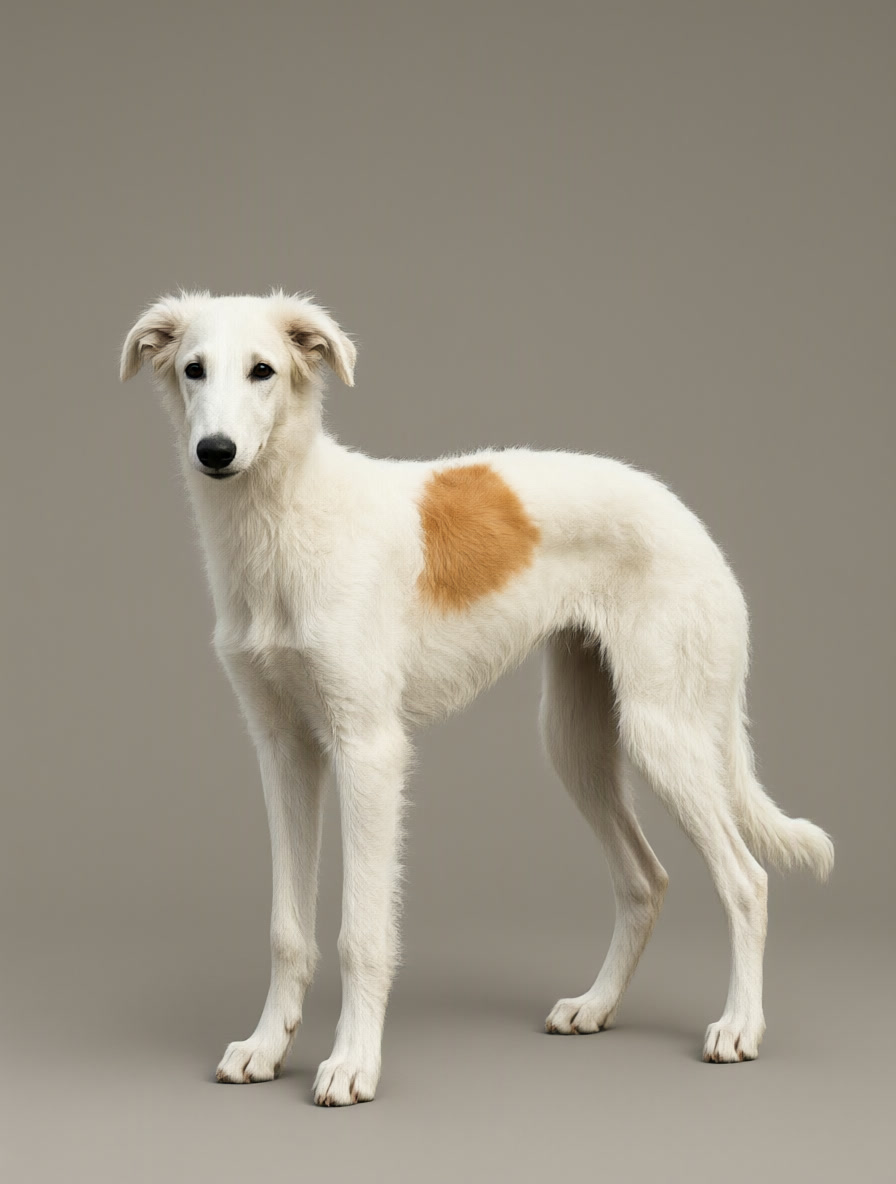
The puppy
Character
Image prompt
Photorealistic live-action period cinema, a provincial Russian market square in 1884; slate-gray overcast daylight, dusty ochre timber and muted brick, restrained colors, natural skin texture, soft highlights, subtle photographic grain, physically plausible cloth and bodies. No readable text, lettering, subtitles, captions, logos or watermarks.
A single film-production identity reference image, not a collage. a small young white borzoi puppy with a long slender muzzle, soft folded ears, dark eyes, thin legs, a slightly fluffy white coat and one distinct warm ochre patch across the upper back; no collar. The complete animal is visible standing in three-quarter side view, paws fully in frame, neutral softly lit warm gray background.
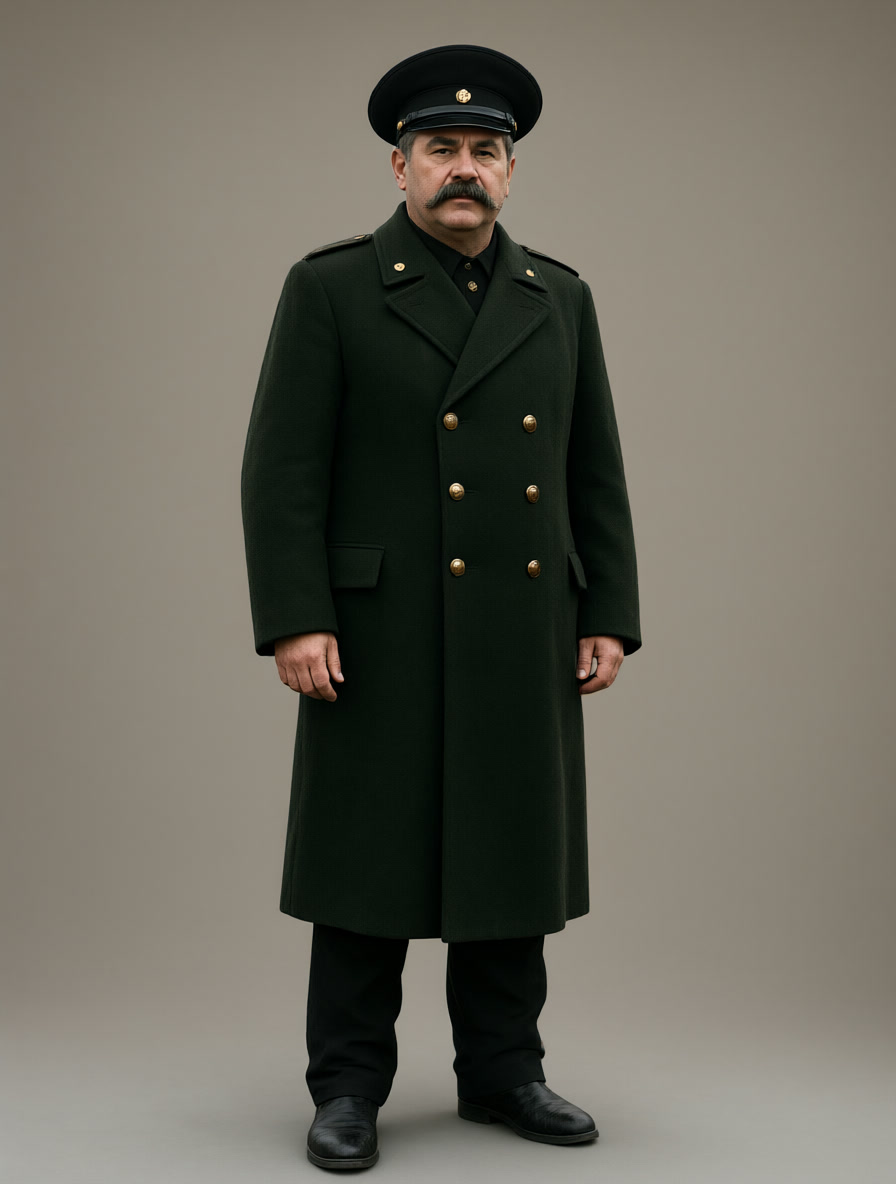
Inspector Ochumelov
Character
Image prompt
Photorealistic live-action period cinema, a provincial Russian market square in 1884; slate-gray overcast daylight, dusty ochre timber and muted brick, restrained colors, natural skin texture, soft highlights, subtle photographic grain, physically plausible cloth and bodies. No readable text, lettering, subtitles, captions, logos or watermarks.
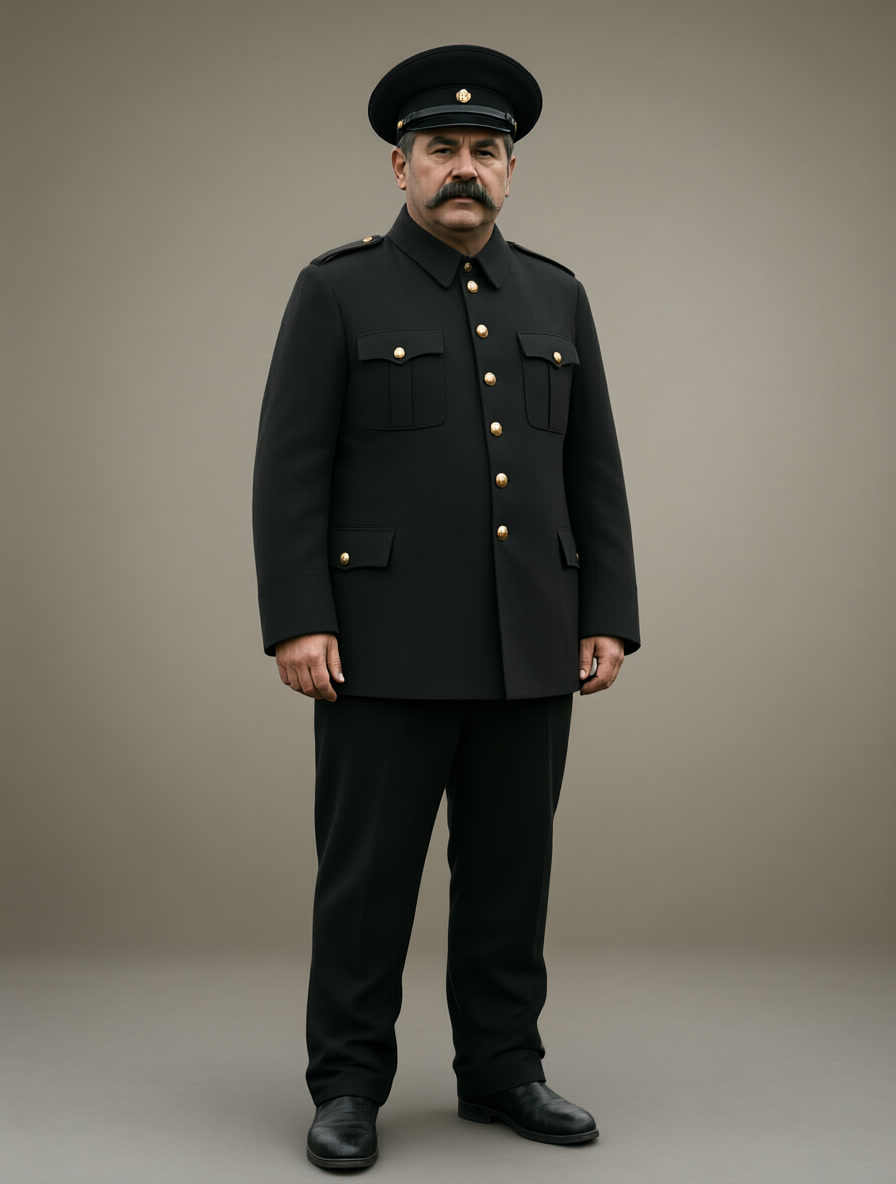
A single film-production identity reference image, not a collage. a broad middle-aged Russian police superintendent with a square ruddy face, heavy dark eyebrows, a thick graying horseshoe moustache, small watchful brown eyes and short dark-gray hair, wearing a dark forest-green double-breasted wool overcoat with brass buttons and a black peaked police cap, black trousers and black leather boots. Single person centered, three-quarter full-length portrait, head and boots fully visible, face large enough to identify, relaxed closed mouth, hands unobstructed, plain softly lit warm gray background. No other people, no equipment, no poster design. Real cloth weave, unretouched face and accurate anatomy.
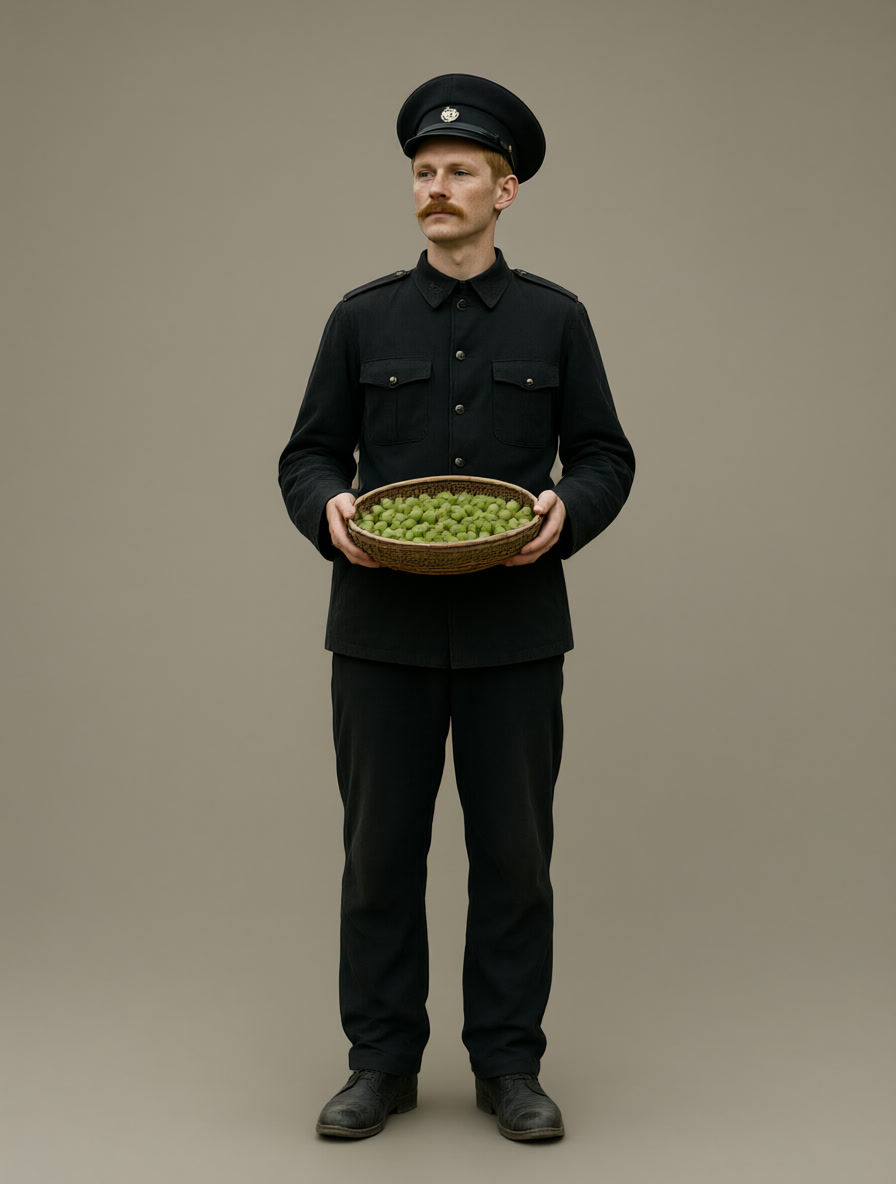
Constable Yeldyrin
Character
Image prompt
Photorealistic live-action period cinema, a provincial Russian market square in 1884; slate-gray overcast daylight, dusty ochre timber and muted brick, restrained colors, natural skin texture, soft highlights, subtle photographic grain, physically plausible cloth and bodies. No readable text, lettering, subtitles, captions, logos or watermarks.
A single film-production identity reference image, not a collage. a tall thin thirty-year-old Russian constable with pale freckled skin, a narrow ginger moustache, short ginger hair, large ears and a deferential expression, wearing a faded dark navy police tunic, a small black peaked cap, dark trousers and boots; he carries a shallow round wicker sieve of green gooseberries. Single person centered, three-quarter full-length portrait, head and boots fully visible, face large enough to identify, relaxed closed mouth, hands unobstructed, plain softly lit warm gray background. No other people, no equipment, no poster design. Real cloth weave, unretouched face and accurate anatomy.
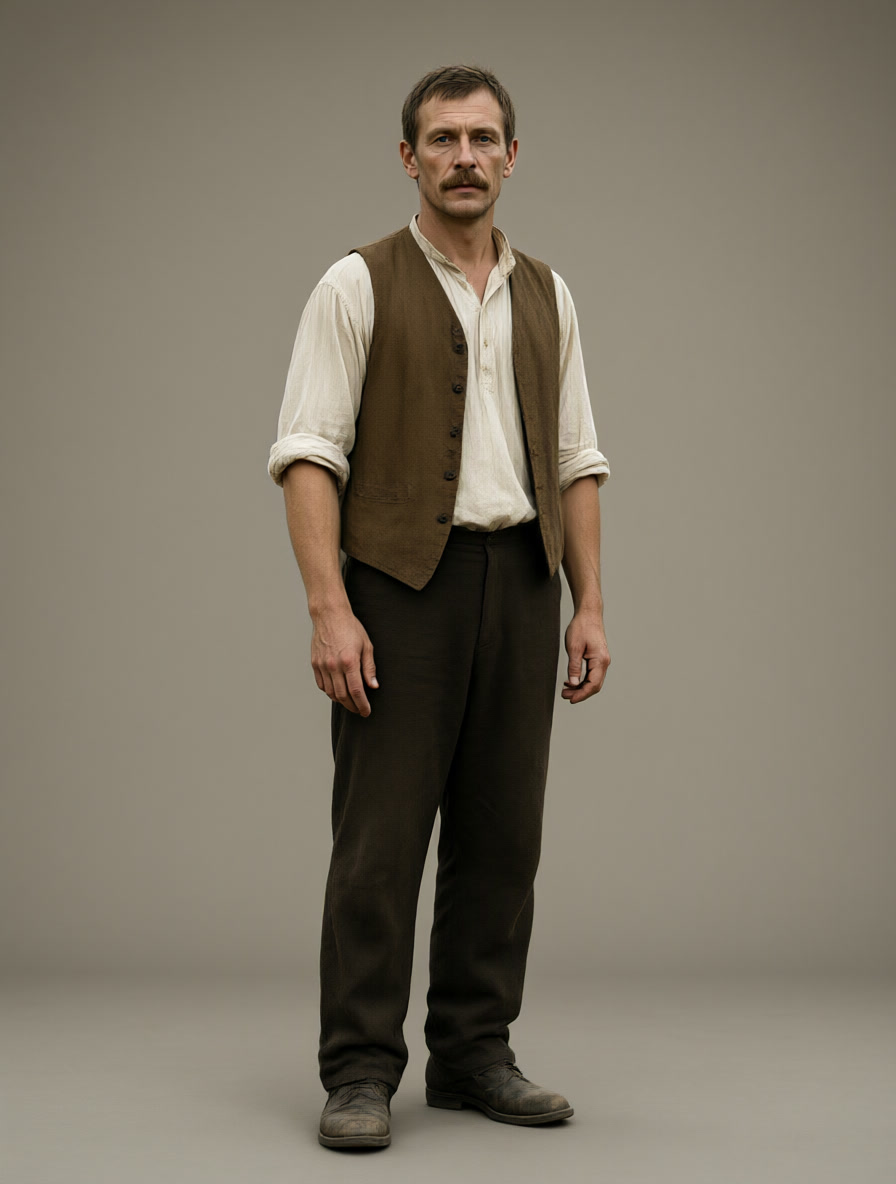
Hryukin the goldsmith
Character
Image prompt
Photorealistic live-action period cinema, a provincial Russian market square in 1884; slate-gray overcast daylight, dusty ochre timber and muted brick, restrained colors, natural skin texture, soft highlights, subtle photographic grain, physically plausible cloth and bodies. No readable text, lettering, subtitles, captions, logos or watermarks.
A single film-production identity reference image, not a collage. a lean forty-year-old Russian goldsmith with a narrow weathered face, uneven short brown hair, a thin brown moustache, prominent cheekbones and tired pale eyes, wearing a wrinkled ivory cotton shirt with rolled sleeves, an unbuttoned tobacco-brown waistcoat, dark brown trousers and scuffed boots; a small red nick marks his right index fingertip. Single person centered, three-quarter full-length portrait, head and boots fully visible, face large enough to identify, relaxed closed mouth, hands unobstructed, plain softly lit warm gray background. No other people, no equipment, no poster design. Real cloth weave, unretouched face and accurate anatomy.
Ochumelov, coat off
Character
Image prompt
Photorealistic live-action period cinema, a provincial Russian market square in 1884; slate-gray overcast daylight, dusty ochre timber and muted brick, restrained colors, natural skin texture, soft highlights, subtle photographic grain, physically plausible cloth and bodies. No readable text, lettering, subtitles, captions, logos or watermarks.
Edit this same man and preserve his exact face, moustache, age, build, cap, pose, trousers, boots, framing and plain background. Remove only the long forest-green overcoat, revealing a fitted charcoal police uniform tunic with brass buttons underneath. Do not change the man or add another person. He does not hold a coat; it is absent from the image.
The general's cook
Character
Image prompt
Photorealistic live-action period cinema, a provincial Russian market square in 1884; slate-gray overcast daylight, dusty ochre timber and muted brick, restrained colors, natural skin texture, soft highlights, subtle photographic grain, physically plausible cloth and bodies. No readable text, lettering, subtitles, captions, logos or watermarks.
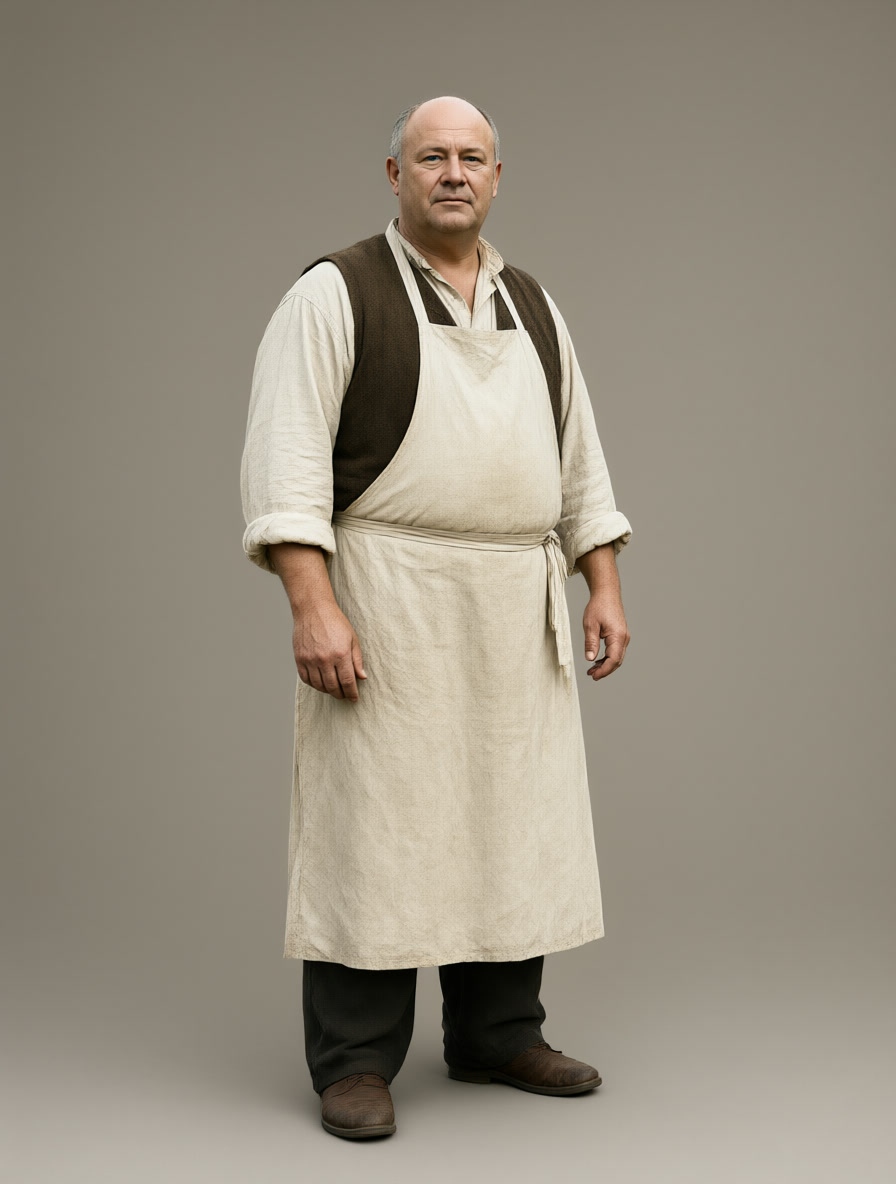
A single film-production identity reference image, not a collage. a stocky fifty-five-year-old Russian household cook with a bald crown, gray hair at the temples, broad clean-shaven face and calm gray eyes, wearing a cream linen work shirt, a long plain off-white apron over dark trousers, a worn brown waistcoat and brown leather shoes. Single person centered, three-quarter full-length portrait, head and boots fully visible, face large enough to identify, relaxed closed mouth, hands unobstructed, plain softly lit warm gray background. No other people, no equipment, no poster design. Real cloth weave, unretouched face and accurate anatomy.
Market square
Location
Image prompt
Photorealistic live-action period cinema, a provincial Russian market square in 1884; slate-gray overcast daylight, dusty ochre timber and muted brick, restrained colors, natural skin texture, soft highlights, subtle photographic grain, physically plausible cloth and bodies. No readable text, lettering, subtitles, captions, logos or watermarks.
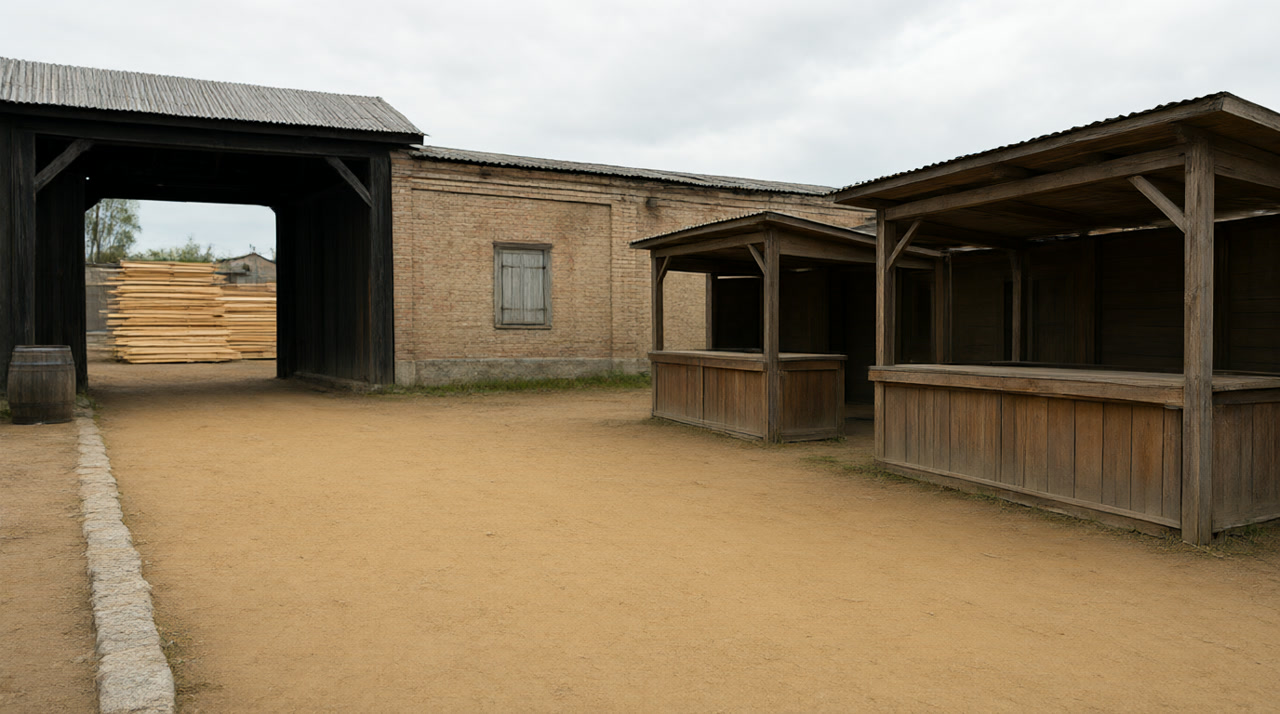
One coherent wide establishing reference photograph of an empty provincial Russian market square in 1884: a broad ochre dirt lane with worn granite edging, an open dark timber-yard gateway at screen left, high neatly stacked pale sawn planks visible beyond it, a weathered brick shop wall with a small shuttered window behind the action, empty timber stalls receding to screen right and a wooden rain barrel beside the gateway; overcast late-summer daylight, dry dust, no writing or signs. Empty of people and animals. Clear readable spatial layout, human eye-level lens, natural deep focus, no modern objects, no signs or writing. Not a collage, no multiple views.
Shot by shot
Each clip below is the raw generation that went into the cut, before music, mixing and captions. Its sound came out of the same generation.
One frightened dog. One bitten finger. Whose justice will it be?
Video prompt
subject_definitions:
<Subject 1> is a small young white borzoi puppy with a long slender muzzle, soft folded ears, dark eyes, thin legs, a slightly fluffy white coat and one distinct warm ochre patch across the upper back; no collar, as shown in <Picture 1>. This reference supplies the puppy’s identity, size and ochre back marking, not its portrait backdrop.
<Subject 2> is an empty provincial Russian market square in 1884: a broad ochre dirt lane with worn granite edging, an open dark timber-yard gateway at screen left, high neatly stacked pale sawn planks visible beyond it, a weathered brick shop wall with a small shuttered window behind the action, empty timber stalls receding to screen right and a wooden rain barrel beside the gateway; overcast late-summer daylight, dry dust, no writing or signs, as shown in <Picture 2>. This reference supplies the set layout, materials and overcast light, not a locked camera view.
summary:
[reference generation] A continuous 8.0000-second live-action period satire shot. The puppy crouches with its forepaws spread, trembling subtly; dust settles against the ochre back patch. Follow the referenced identities and market layout while developing the directed action.
retention_analysis:
<Subject 1> (appears in [Shot 1]): fully_preserved - Preserve the same small white borzoi puppy, slender muzzle, folded ears, ochre upper-back patch and no collar. Preserve the defined reference role while allowing the actions in this shot.
<Subject 2> (appears in [Shot 1]): fully_preserved - Preserve the gate on the left, stacked pale planks, brick shop wall, granite edging, rain barrel and lane to the right; same overcast afternoon throughout. Preserve the defined reference role while allowing the actions in this shot.
detailed_description:
Photorealistic live-action period cinema, a provincial Russian market square in 1884; slate-gray overcast daylight, dusty ochre timber and muted brick, restrained colors, natural skin texture, soft highlights, subtle photographic grain, physically plausible cloth and bodies. No readable text, lettering, subtitles, captions, logos or watermarks.
[Shot 1] One continuous 8.0000-second shot, with no internal edit. Low dog-eye-level close view beside the timber-yard gate; puppy lower left, a broad empty dirt lane on the right. Gentle short push toward its eyes.
The location is <Subject 2>. The referenced gate, stacked planks, brick wall and barrel define the same small patch of market, not a different street. Camera and blocking preserve the yard-to-lane geography, with the gateway on the established left and the exit toward the right. On-screen referenced characters are <Subject 1>. Introduce their visible reference features clearly without treating a portrait as a physical background.
The puppy crouches with its forepaws spread, trembling subtly; dust settles against the ochre back patch. A blurred male boot stops safely a foot away. At two seconds, the unseen narrator speaks; nobody visible moves their lips. The puppy glances toward the lane, never injured or handled roughly.
At the specified speaking window, the unseen narrator, in a calm, dry, low-register female narrator voice, mature and gently ironic, speaking clear English in a standard British accent at a measured pace (S5), says in an off-screen voiceover, quietly, with dry curiosity, from second two through second seven: <d>[English] One frightened dog. One bitten finger. Whose justice will it be?</d>. All visible characters keep their lips closed during this off-screen voice.
Textures remain tangible: felt cap edges, matte wool or linen weave, worn grain on the gateway, irregular dust around boots and soft creases responding to each small movement. Daylight remains diffused from the upper left; shadows stay soft and short, with no sun suddenly appearing. Faces retain natural pores, small asymmetries and eye reflections rather than polished mannequin skin. Keep all movement physically grounded, with no duplicated limbs, people or props. The framing reveals only the gestures it can actually see; do not invent a new subplot or a cutaway.
End on the puppy looking up toward the approaching boots; next shot reveals the approaching officer.
Maintain the scene and current costume to the end. Keep at least a small breath of silence after the final spoken words; no unfinished syllable at the cut. Mouth movements follow only the written English lines. No additional intelligible dialogue, ad-libbed explanations, spoken directions, subtitles or readable writing. Background people, if specified, remain indistinct and do not resemble or duplicate the referenced leads. The puppy, when visible, is safe throughout; threats are words only, with no violence enacted.
overall_soundscape:
Thin wind, soft paw movement in dry grit, a small uncertain whine; no additional words. Nonverbal listener reactions only where directed; preserve quiet gaps and natural outdoor acoustic space.
non_diegetic_music:
N/A
Trouble by the timber yard, sir. A man says he has been bitten.
Video prompt
subject_definitions:
<Subject 1> is a broad middle-aged Russian police superintendent with a square ruddy face, heavy dark eyebrows, a thick graying horseshoe moustache, small watchful brown eyes and short dark-gray hair, wearing a dark forest-green double-breasted wool overcoat with brass buttons and a black peaked police cap, black trousers and black leather boots, as shown in <Picture 1>. This reference supplies character identity and the specified costume only; its neutral portrait backdrop is not the story location.
<Subject 2> is a tall thin thirty-year-old Russian constable with pale freckled skin, a narrow ginger moustache, short ginger hair, large ears and a deferential expression, wearing a faded dark navy police tunic, a small black peaked cap, dark trousers and boots; he carries a shallow round wicker sieve of green gooseberries, as shown in <Picture 2>. This reference supplies character identity and the specified costume only; its neutral portrait backdrop is not the story location.
<Subject 3> is an empty provincial Russian market square in 1884: a broad ochre dirt lane with worn granite edging, an open dark timber-yard gateway at screen left, high neatly stacked pale sawn planks visible beyond it, a weathered brick shop wall with a small shuttered window behind the action, empty timber stalls receding to screen right and a wooden rain barrel beside the gateway; overcast late-summer daylight, dry dust, no writing or signs, as shown in <Picture 3>. This reference supplies the set layout, materials and overcast light, not a locked camera view.
summary:
[reference generation] A continuous 10.1250-second live-action period satire shot. The superintendent walks stiffly, his green coat fully on and buttoned, one gloved hand smoothing its lapel. Follow the referenced identities and market layout while developing the directed action.
retention_analysis:
<Subject 1> (appears in [Shot 1]): fully_preserved - Preserve the same square face, heavy brows, graying horseshoe moustache, peaked cap, forest-green overcoat and black boots. Preserve the defined reference role while allowing the actions in this shot.
<Subject 2> (appears in [Shot 1]): fully_preserved - Preserve the same tall thin frame, freckled face, ginger moustache, navy uniform and gooseberry sieve. Preserve the defined reference role while allowing the actions in this shot.
<Subject 3> (appears in [Shot 1]): fully_preserved - Preserve the gate on the left, stacked pale planks, brick shop wall, granite edging, rain barrel and lane to the right; same overcast afternoon throughout. Preserve the defined reference role while allowing the actions in this shot.
detailed_description:
Photorealistic live-action period cinema, a provincial Russian market square in 1884; slate-gray overcast daylight, dusty ochre timber and muted brick, restrained colors, natural skin texture, soft highlights, subtle photographic grain, physically plausible cloth and bodies. No readable text, lettering, subtitles, captions, logos or watermarks.
[Shot 1] One continuous 10.1250-second shot, with no internal edit. Medium-wide two-shot; superintendent enters from screen right, constable half a step behind. Slow lateral tracking keeps the timber-yard gateway on the left.
The location is <Subject 3>. The referenced gate, stacked planks, brick wall and barrel define the same small patch of market, not a different street. Camera and blocking preserve the yard-to-lane geography, with the gateway on the established left and the exit toward the right. On-screen referenced characters are <Subject 1>, <Subject 2>. Introduce their visible reference features clearly without treating a portrait as a physical background.
The superintendent walks stiffly, his green coat fully on and buttoned, one gloved hand smoothing its lapel. The constable balances his sieve in both hands. A commotion off left makes them stop; the constable inclines his head toward it and speaks. They look toward the gateway without crossing the established axis.
At the specified speaking window, <Subject 2>, in a lighter mid-register male voice, dry and hesitant, speaking clear English in a standard British accent, with cautious pauses and respectful restrained volume (S3), says, respectfully, between seconds two and eight: <d>[English] Trouble by the timber yard, sir. A man says he has been bitten.</d>. Only this character’s lips move for this line; all listeners remain silent.
Textures remain tangible: felt cap edges, matte wool or linen weave, worn grain on the gateway, irregular dust around boots and soft creases responding to each small movement. Daylight remains diffused from the upper left; shadows stay soft and short, with no sun suddenly appearing. Faces retain natural pores, small asymmetries and eye reflections rather than polished mannequin skin. Keep all movement physically grounded, with no duplicated limbs, people or props. The framing reveals only the gestures it can actually see; do not invent a new subplot or a cutaway.
Hold the final gaze or pose briefly; cut at the natural pause to the next reaction.
Maintain the scene and current costume to the end. Keep at least a small breath of silence after the final spoken words; no unfinished syllable at the cut. Mouth movements follow only the written English lines. No additional intelligible dialogue, ad-libbed explanations, spoken directions, subtitles or readable writing. Background people, if specified, remain indistinct and do not resemble or duplicate the referenced leads. The puppy, when visible, is safe throughout; threats are words only, with no violence enacted.
overall_soundscape:
A faint wind passes across the quiet square, with distant sparrows and soft leather boot scuffs. Nonverbal listener reactions only where directed; preserve quiet gaps and natural outdoor acoustic space.
non_diegetic_music:
N/A
I did nothing! It bit this finger. I am a goldsmith, sir. How am I supposed to work?
Video prompt
subject_definitions:
<Subject 1> is a lean forty-year-old Russian goldsmith with a narrow weathered face, uneven short brown hair, a thin brown moustache, prominent cheekbones and tired pale eyes, wearing a wrinkled ivory cotton shirt with rolled sleeves, an unbuttoned tobacco-brown waistcoat, dark brown trousers and scuffed boots; a small red nick marks his right index fingertip, as shown in <Picture 1>. This reference supplies character identity and the specified costume only; its neutral portrait backdrop is not the story location.
<Subject 2> is a broad middle-aged Russian police superintendent with a square ruddy face, heavy dark eyebrows, a thick graying horseshoe moustache, small watchful brown eyes and short dark-gray hair, wearing a dark forest-green double-breasted wool overcoat with brass buttons and a black peaked police cap, black trousers and black leather boots, as shown in <Picture 2>. This reference supplies character identity and the specified costume only; its neutral portrait backdrop is not the story location.
<Subject 3> is an empty provincial Russian market square in 1884: a broad ochre dirt lane with worn granite edging, an open dark timber-yard gateway at screen left, high neatly stacked pale sawn planks visible beyond it, a weathered brick shop wall with a small shuttered window behind the action, empty timber stalls receding to screen right and a wooden rain barrel beside the gateway; overcast late-summer daylight, dry dust, no writing or signs, as shown in <Picture 3>. This reference supplies the set layout, materials and overcast light, not a locked camera view.
summary:
[reference generation] A continuous 12.2500-second live-action period satire shot. The goldsmith holds his right index finger up at chest height like an exhibit; its nick is tiny, with no dripping blood. Follow the referenced identities and market layout while developing the directed action.
retention_analysis:
<Subject 1> (appears in [Shot 1]): fully_preserved - Preserve the same gaunt face, thin brown moustache, ivory shirt, open tobacco-brown waistcoat and small right-index-finger nick. Preserve the defined reference role while allowing the actions in this shot.
<Subject 2> (appears in [Shot 1]): fully_preserved - Preserve the same square face, heavy brows, graying horseshoe moustache, peaked cap, forest-green overcoat and black boots. Preserve the defined reference role while allowing the actions in this shot.
<Subject 3> (appears in [Shot 1]): fully_preserved - Preserve the gate on the left, stacked pale planks, brick shop wall, granite edging, rain barrel and lane to the right; same overcast afternoon throughout. Preserve the defined reference role while allowing the actions in this shot.
detailed_description:
Photorealistic live-action period cinema, a provincial Russian market square in 1884; slate-gray overcast daylight, dusty ochre timber and muted brick, restrained colors, natural skin texture, soft highlights, subtle photographic grain, physically plausible cloth and bodies. No readable text, lettering, subtitles, captions, logos or watermarks.
[Shot 1] One continuous 12.2500-second shot, with no internal edit. Medium view of the goldsmith by the gateway, superintendent visible in profile on the right edge; a small crowd remains softly out of focus.
The location is <Subject 3>. The referenced gate, stacked planks, brick wall and barrel define the same small patch of market, not a different street. Camera and blocking preserve the yard-to-lane geography, with the gateway on the established left and the exit toward the right. On-screen referenced characters are <Subject 1>, <Subject 2>. Introduce their visible reference features clearly without treating a portrait as a physical background.
The goldsmith holds his right index finger up at chest height like an exhibit; its nick is tiny, with no dripping blood. He faces screen right toward the officer, keeping his left hand against his open waistcoat. He pleads, then opens his left palm to demand compensation. The officer listens without speaking or changing coat.
At the specified speaking window, <Subject 1>, in a dry reedy tenor voice of an adult man, slightly rough and breathy, speaking clear English in a standard British accent, quick pleading phrases separated by small indignant breaths (S2), says, indignantly but intelligibly, seconds one through ten: <d>[English] I did nothing! It bit this finger. I am a goldsmith, sir. How am I supposed to work?</d>. Only this character’s lips move for this line; all listeners remain silent.
Textures remain tangible: felt cap edges, matte wool or linen weave, worn grain on the gateway, irregular dust around boots and soft creases responding to each small movement. Daylight remains diffused from the upper left; shadows stay soft and short, with no sun suddenly appearing. Faces retain natural pores, small asymmetries and eye reflections rather than polished mannequin skin. Keep all movement physically grounded, with no duplicated limbs, people or props. The framing reveals only the gestures it can actually see; do not invent a new subplot or a cutaway.
Hold the final gaze or pose briefly; cut at the natural pause to the next reaction.
Maintain the scene and current costume to the end. Keep at least a small breath of silence after the final spoken words; no unfinished syllable at the cut. Mouth movements follow only the written English lines. No additional intelligible dialogue, ad-libbed explanations, spoken directions, subtitles or readable writing. Background people, if specified, remain indistinct and do not resemble or duplicate the referenced leads. The puppy, when visible, is safe throughout; threats are words only, with no violence enacted.
overall_soundscape:
A faint wind passes across the quiet square, with distant sparrows and soft leather boot scuffs. Nonverbal listener reactions only where directed; preserve quiet gaps and natural outdoor acoustic space.
non_diegetic_music:
N/A
A dangerous stray. We cannot allow this. Find its owner, write a report, and have the animal put down.
Video prompt
subject_definitions:
<Subject 1> is a broad middle-aged Russian police superintendent with a square ruddy face, heavy dark eyebrows, a thick graying horseshoe moustache, small watchful brown eyes and short dark-gray hair, wearing a dark forest-green double-breasted wool overcoat with brass buttons and a black peaked police cap, black trousers and black leather boots, as shown in <Picture 1>. This reference supplies character identity and the specified costume only; its neutral portrait backdrop is not the story location.
<Subject 2> is a small young white borzoi puppy with a long slender muzzle, soft folded ears, dark eyes, thin legs, a slightly fluffy white coat and one distinct warm ochre patch across the upper back; no collar, as shown in <Picture 2>. This reference supplies the puppy’s identity, size and ochre back marking, not its portrait backdrop.
<Subject 3> is an empty provincial Russian market square in 1884: a broad ochre dirt lane with worn granite edging, an open dark timber-yard gateway at screen left, high neatly stacked pale sawn planks visible beyond it, a weathered brick shop wall with a small shuttered window behind the action, empty timber stalls receding to screen right and a wooden rain barrel beside the gateway; overcast late-summer daylight, dry dust, no writing or signs, as shown in <Picture 3>. This reference supplies the set layout, materials and overcast light, not a locked camera view.
summary:
[reference generation] A continuous 12.2500-second live-action period satire shot. The superintendent draws himself upright and raises one admonishing index finger. Follow the referenced identities and market layout while developing the directed action.
retention_analysis:
<Subject 1> (appears in [Shot 1]): fully_preserved - Preserve the same square face, heavy brows, graying horseshoe moustache, peaked cap, forest-green overcoat and black boots. Preserve the defined reference role while allowing the actions in this shot.
<Subject 2> (appears in [Shot 1]): fully_preserved - Preserve the same small white borzoi puppy, slender muzzle, folded ears, ochre upper-back patch and no collar. Preserve the defined reference role while allowing the actions in this shot.
<Subject 3> (appears in [Shot 1]): fully_preserved - Preserve the gate on the left, stacked pale planks, brick shop wall, granite edging, rain barrel and lane to the right; same overcast afternoon throughout. Preserve the defined reference role while allowing the actions in this shot.
detailed_description:
Photorealistic live-action period cinema, a provincial Russian market square in 1884; slate-gray overcast daylight, dusty ochre timber and muted brick, restrained colors, natural skin texture, soft highlights, subtle photographic grain, physically plausible cloth and bodies. No readable text, lettering, subtitles, captions, logos or watermarks.
[Shot 1] One continuous 12.2500-second shot, with no internal edit. Medium-low view of superintendent looking down screen left at the puppy, which sits safely beside the gateway. A restrained push emphasizes official importance.
The location is <Subject 3>. The referenced gate, stacked planks, brick wall and barrel define the same small patch of market, not a different street. Camera and blocking preserve the yard-to-lane geography, with the gateway on the established left and the exit toward the right. On-screen referenced characters are <Subject 1>, <Subject 2>. Introduce their visible reference features clearly without treating a portrait as a physical background.
The superintendent draws himself upright and raises one admonishing index finger. The puppy stays seated a safe arm length away. The officer gives his verdict toward the dog, then turns his chin toward the unseen constable on his right. No one touches or harms the animal.
At the specified speaking window, <Subject 1>, in a resonant low baritone voice of a middle-aged man, slightly nasal, clipped consonants, measured English in a clear standard British accent, with pompous official precision (S1), says, sternly, seconds one through ten: <d>[English] A dangerous stray. We cannot allow this. Find its owner, write a report, and have the animal put down.</d>. Only this character’s lips move for this line; all listeners remain silent.
Textures remain tangible: felt cap edges, matte wool or linen weave, worn grain on the gateway, irregular dust around boots and soft creases responding to each small movement. Daylight remains diffused from the upper left; shadows stay soft and short, with no sun suddenly appearing. Faces retain natural pores, small asymmetries and eye reflections rather than polished mannequin skin. Keep all movement physically grounded, with no duplicated limbs, people or props. The framing reveals only the gestures it can actually see; do not invent a new subplot or a cutaway.
Hold the final gaze or pose briefly; cut at the natural pause to the next reaction.
Maintain the scene and current costume to the end. Keep at least a small breath of silence after the final spoken words; no unfinished syllable at the cut. Mouth movements follow only the written English lines. No additional intelligible dialogue, ad-libbed explanations, spoken directions, subtitles or readable writing. Background people, if specified, remain indistinct and do not resemble or duplicate the referenced leads. The puppy, when visible, is safe throughout; threats are words only, with no violence enacted.
overall_soundscape:
A faint wind passes across the quiet square, with distant sparrows and soft leather boot scuffs. Nonverbal listener reactions only where directed; preserve quiet gaps and natural outdoor acoustic space.
non_diegetic_music:
N/A
subject_definitions:
<Subject 1> is a tall thin thirty-year-old Russian constable with pale freckled skin, a narrow ginger moustache, short ginger hair, large ears and a deferential expression, wearing a faded dark navy police tunic, a small black peaked cap, dark trousers and boots; he carries a shallow round wicker sieve of green gooseberries, as shown in <Picture 1>. This reference supplies character identity and the specified costume only; its neutral portrait backdrop is not the story location.
<Subject 2> is a broad middle-aged Russian police superintendent with a square ruddy face, heavy dark eyebrows, a thick graying horseshoe moustache, small watchful brown eyes and short dark-gray hair, wearing a dark forest-green double-breasted wool overcoat with brass buttons and a black peaked police cap, black trousers and black leather boots, as shown in <Picture 2>. This reference supplies character identity and the specified costume only; its neutral portrait backdrop is not the story location.
<Subject 3> is an empty provincial Russian market square in 1884: a broad ochre dirt lane with worn granite edging, an open dark timber-yard gateway at screen left, high neatly stacked pale sawn planks visible beyond it, a weathered brick shop wall with a small shuttered window behind the action, empty timber stalls receding to screen right and a wooden rain barrel beside the gateway; overcast late-summer daylight, dry dust, no writing or signs, as shown in <Picture 3>. This reference supplies the set layout, materials and overcast light, not a locked camera view.
summary:
[reference generation] A continuous 8.0000-second live-action period satire shot. The constable shifts the sieve against his waist and glances toward an indistinct bystander outside frame. Follow the referenced identities and market layout while developing the directed action.
retention_analysis:
<Subject 1> (appears in [Shot 1]): fully_preserved - Preserve the same tall thin frame, freckled face, ginger moustache, navy uniform and gooseberry sieve. Preserve the defined reference role while allowing the actions in this shot.
<Subject 2> (appears in [Shot 1]): fully_preserved - Preserve the same square face, heavy brows, graying horseshoe moustache, peaked cap, forest-green overcoat and black boots. Preserve the defined reference role while allowing the actions in this shot.
<Subject 3> (appears in [Shot 1]): fully_preserved - Preserve the gate on the left, stacked pale planks, brick shop wall, granite edging, rain barrel and lane to the right; same overcast afternoon throughout. Preserve the defined reference role while allowing the actions in this shot.
detailed_description:
Photorealistic live-action period cinema, a provincial Russian market square in 1884; slate-gray overcast daylight, dusty ochre timber and muted brick, restrained colors, natural skin texture, soft highlights, subtle photographic grain, physically plausible cloth and bodies. No readable text, lettering, subtitles, captions, logos or watermarks.
[Shot 1] One continuous 8.0000-second shot, with no internal edit. Medium close view of constable over the superintendent’s green-coated shoulder. Static composition, constable looks screen left toward the officer.
The location is <Subject 3>. The referenced gate, stacked planks, brick wall and barrel define the same small patch of market, not a different street. Camera and blocking preserve the yard-to-lane geography, with the gateway on the established left and the exit toward the right. On-screen referenced characters are <Subject 1>, <Subject 2>. Introduce their visible reference features clearly without treating a portrait as a physical background.
The constable shifts the sieve against his waist and glances toward an indistinct bystander outside frame. He lowers his voice while the superintendent remains listening in foreground. Leave a short pause after the name.
At the specified speaking window, <Subject 1>, in a lighter mid-register male voice, dry and hesitant, speaking clear English in a standard British accent, with cautious pauses and respectful restrained volume (S3), says, cautiously, seconds two through six: <d>[English] Someone says it belongs to General Zhigalov, sir.</d>. Only this character’s lips move for this line; all listeners remain silent.
Textures remain tangible: felt cap edges, matte wool or linen weave, worn grain on the gateway, irregular dust around boots and soft creases responding to each small movement. Daylight remains diffused from the upper left; shadows stay soft and short, with no sun suddenly appearing. Faces retain natural pores, small asymmetries and eye reflections rather than polished mannequin skin. Keep all movement physically grounded, with no duplicated limbs, people or props. The framing reveals only the gestures it can actually see; do not invent a new subplot or a cutaway.
Hold the final gaze or pose briefly; cut at the natural pause to the next reaction.
Maintain the scene and current costume to the end. Keep at least a small breath of silence after the final spoken words; no unfinished syllable at the cut. Mouth movements follow only the written English lines. No additional intelligible dialogue, ad-libbed explanations, spoken directions, subtitles or readable writing. Background people, if specified, remain indistinct and do not resemble or duplicate the referenced leads. The puppy, when visible, is safe throughout; threats are words only, with no violence enacted.
overall_soundscape:
A faint wind passes across the quiet square, with distant sparrows and soft leather boot scuffs. Nonverbal listener reactions only where directed; preserve quiet gaps and natural outdoor acoustic space.
non_diegetic_music:
N/A
The General? Help me with my coat. Dreadfully hot. Now, how could such a tiny creature possibly reach your hand?
Video prompt
subject_definitions:
<Subject 1> is a broad middle-aged Russian police superintendent with a square ruddy face, heavy dark eyebrows, a thick graying horseshoe moustache, small watchful brown eyes and short dark-gray hair, wearing a dark forest-green double-breasted wool overcoat with brass buttons and a black peaked police cap, black trousers and black leather boots, as shown in <Picture 1>. This reference supplies character identity and the specified costume only; its neutral portrait backdrop is not the story location.
<Subject 2> is a tall thin thirty-year-old Russian constable with pale freckled skin, a narrow ginger moustache, short ginger hair, large ears and a deferential expression, wearing a faded dark navy police tunic, a small black peaked cap, dark trousers and boots; he carries a shallow round wicker sieve of green gooseberries, as shown in <Picture 2>. This reference supplies character identity and the specified costume only; its neutral portrait backdrop is not the story location.
<Subject 3> is an empty provincial Russian market square in 1884: a broad ochre dirt lane with worn granite edging, an open dark timber-yard gateway at screen left, high neatly stacked pale sawn planks visible beyond it, a weathered brick shop wall with a small shuttered window behind the action, empty timber stalls receding to screen right and a wooden rain barrel beside the gateway; overcast late-summer daylight, dry dust, no writing or signs, as shown in <Picture 3>. This reference supplies the set layout, materials and overcast light, not a locked camera view.
summary:
[reference generation] A continuous 12.2500-second live-action period satire shot. At the word General, the superintendent’s raised hand freezes. Follow the referenced identities and market layout while developing the directed action.
retention_analysis:
<Subject 1> (appears in [Shot 1]): fully_preserved - Preserve the same square face, heavy brows, graying horseshoe moustache, peaked cap, forest-green overcoat and black boots. Preserve the defined reference role while allowing the actions in this shot.
<Subject 2> (appears in [Shot 1]): fully_preserved - Preserve the same tall thin frame, freckled face, ginger moustache, navy uniform and gooseberry sieve. Preserve the defined reference role while allowing the actions in this shot.
<Subject 3> (appears in [Shot 1]): fully_preserved - Preserve the gate on the left, stacked pale planks, brick shop wall, granite edging, rain barrel and lane to the right; same overcast afternoon throughout. Preserve the defined reference role while allowing the actions in this shot.
detailed_description:
Photorealistic live-action period cinema, a provincial Russian market square in 1884; slate-gray overcast daylight, dusty ochre timber and muted brick, restrained colors, natural skin texture, soft highlights, subtle photographic grain, physically plausible cloth and bodies. No readable text, lettering, subtitles, captions, logos or watermarks.
[Shot 1] One continuous 12.2500-second shot, with no internal edit. Medium two-shot at the same gateway. Superintendent left of constable; green coat still fully on at opening.
The location is <Subject 3>. The referenced gate, stacked planks, brick wall and barrel define the same small patch of market, not a different street. Camera and blocking preserve the yard-to-lane geography, with the gateway on the established left and the exit toward the right. On-screen referenced characters are <Subject 1>, <Subject 2>. Introduce their visible reference features clearly without treating a portrait as a physical background.
At the word General, the superintendent’s raised hand freezes. He swallows, opens his green coat at the throat and loosens its lapels, then reaches one elbow backward as the constable offers assistance. Do not complete the removal on camera; end with loosened coat still on his shoulders, so the next angle may reveal it already removed. His tone softens before he questions the goldsmith off left.
At the specified speaking window, <Subject 1>, in a resonant low baritone voice of a middle-aged man, slightly nasal, clipped consonants, measured English in a clear standard British accent, with pompous official precision (S1), says, first startled, then falsely reasonable, seconds one through eleven: <d>[English] The General? Help me with my coat. Dreadfully hot. Now, how could such a tiny creature possibly reach your hand?</d>. Only this character’s lips move for this line; all listeners remain silent.
Textures remain tangible: felt cap edges, matte wool or linen weave, worn grain on the gateway, irregular dust around boots and soft creases responding to each small movement. Daylight remains diffused from the upper left; shadows stay soft and short, with no sun suddenly appearing. Faces retain natural pores, small asymmetries and eye reflections rather than polished mannequin skin. Keep all movement physically grounded, with no duplicated limbs, people or props. The framing reveals only the gestures it can actually see; do not invent a new subplot or a cutaway.
Cut away during the coat adjustment; later coat-off view is an explicit continuity change, not an accidental outfit drift.
Maintain the scene and current costume to the end. Keep at least a small breath of silence after the final spoken words; no unfinished syllable at the cut. Mouth movements follow only the written English lines. No additional intelligible dialogue, ad-libbed explanations, spoken directions, subtitles or readable writing. Background people, if specified, remain indistinct and do not resemble or duplicate the referenced leads. The puppy, when visible, is safe throughout; threats are words only, with no violence enacted.
overall_soundscape:
A faint wind passes across the quiet square, with distant sparrows and soft leather boot scuffs. Nonverbal listener reactions only where directed; preserve quiet gaps and natural outdoor acoustic space.
non_diegetic_music:
N/A
You pushed a cigarette at its nose! I saw you. A lie! Let the law decide. We are all equal!
Video prompt
subject_definitions:
<Subject 1> is a lean forty-year-old Russian goldsmith with a narrow weathered face, uneven short brown hair, a thin brown moustache, prominent cheekbones and tired pale eyes, wearing a wrinkled ivory cotton shirt with rolled sleeves, an unbuttoned tobacco-brown waistcoat, dark brown trousers and scuffed boots; a small red nick marks his right index fingertip, as shown in <Picture 1>. This reference supplies character identity and the specified costume only; its neutral portrait backdrop is not the story location.
<Subject 2> is an empty provincial Russian market square in 1884: a broad ochre dirt lane with worn granite edging, an open dark timber-yard gateway at screen left, high neatly stacked pale sawn planks visible beyond it, a weathered brick shop wall with a small shuttered window behind the action, empty timber stalls receding to screen right and a wooden rain barrel beside the gateway; overcast late-summer daylight, dry dust, no writing or signs, as shown in <Picture 2>. This reference supplies the set layout, materials and overcast light, not a locked camera view.
summary:
[reference generation] A continuous 12.2500-second live-action period satire shot. The goldsmith keeps his injured right index finger aloft. Follow the referenced identities and market layout while developing the directed action.
retention_analysis:
<Subject 1> (appears in [Shot 1]): fully_preserved - Preserve the same gaunt face, thin brown moustache, ivory shirt, open tobacco-brown waistcoat and small right-index-finger nick. Preserve the defined reference role while allowing the actions in this shot.
<Subject 2> (appears in [Shot 1]): fully_preserved - Preserve the gate on the left, stacked pale planks, brick shop wall, granite edging, rain barrel and lane to the right; same overcast afternoon throughout. Preserve the defined reference role while allowing the actions in this shot.
detailed_description:
Photorealistic live-action period cinema, a provincial Russian market square in 1884; slate-gray overcast daylight, dusty ochre timber and muted brick, restrained colors, natural skin texture, soft highlights, subtle photographic grain, physically plausible cloth and bodies. No readable text, lettering, subtitles, captions, logos or watermarks.
[Shot 1] One continuous 12.2500-second shot, with no internal edit. Close view of the goldsmith, blurred crowd behind him; no superintendent visible. Static camera at human eye level.
The location is <Subject 2>. The referenced gate, stacked planks, brick wall and barrel define the same small patch of market, not a different street. Camera and blocking preserve the yard-to-lane geography, with the gateway on the established left and the exit toward the right. On-screen referenced characters are <Subject 1>. Introduce their visible reference features clearly without treating a portrait as a physical background.
The goldsmith keeps his injured right index finger aloft. At two seconds, an unseen bystander speaks while his lips remain closed; his face tightens as he listens. He then snaps his gaze toward the heckler and delivers his denial, dropping his left hand sharply. Two background townspeople remain indistinct and never lip-sync the words.
At the specified speaking window, an unseen male bystander, in a wiry adult male voice, higher in pitch than the other men, blunt and colloquial, speaking clear English in a standard British accent (S6), says in an off-screen voiceover, in an off-screen voiceover, accusing, seconds one through five: <d>[English] You pushed a cigarette at its nose! I saw you.</d>. All visible characters keep their lips closed during this off-screen voice. At the specified speaking window, <Subject 1>, in a dry reedy tenor voice of an adult man, slightly rough and breathy, speaking clear English in a standard British accent, quick pleading phrases separated by small indignant breaths (S2), says, defensively, seconds six through ten: <d>[English] A lie! Let the law decide. We are all equal!</d>. Only this character’s lips move for this line; all listeners remain silent.
Textures remain tangible: felt cap edges, matte wool or linen weave, worn grain on the gateway, irregular dust around boots and soft creases responding to each small movement. Daylight remains diffused from the upper left; shadows stay soft and short, with no sun suddenly appearing. Faces retain natural pores, small asymmetries and eye reflections rather than polished mannequin skin. Keep all movement physically grounded, with no duplicated limbs, people or props. The framing reveals only the gestures it can actually see; do not invent a new subplot or a cutaway.
Hold the final gaze or pose briefly; cut at the natural pause to the next reaction.
Maintain the scene and current costume to the end. Keep at least a small breath of silence after the final spoken words; no unfinished syllable at the cut. Mouth movements follow only the written English lines. No additional intelligible dialogue, ad-libbed explanations, spoken directions, subtitles or readable writing. Background people, if specified, remain indistinct and do not resemble or duplicate the referenced leads. The puppy, when visible, is safe throughout; threats are words only, with no violence enacted.
overall_soundscape:
A faint wind passes across the quiet square, with distant sparrows and soft leather boot scuffs. Nonverbal listener reactions only where directed; preserve quiet gaps and natural outdoor acoustic space.
non_diegetic_music:
N/A
No, sir. It cannot be the General’s. His dogs are setters. I know them.
Video prompt
subject_definitions:
<Subject 1> is a tall thin thirty-year-old Russian constable with pale freckled skin, a narrow ginger moustache, short ginger hair, large ears and a deferential expression, wearing a faded dark navy police tunic, a small black peaked cap, dark trousers and boots; he carries a shallow round wicker sieve of green gooseberries, as shown in <Picture 1>. This reference supplies character identity and the specified costume only; its neutral portrait backdrop is not the story location.
<Subject 2> is an empty provincial Russian market square in 1884: a broad ochre dirt lane with worn granite edging, an open dark timber-yard gateway at screen left, high neatly stacked pale sawn planks visible beyond it, a weathered brick shop wall with a small shuttered window behind the action, empty timber stalls receding to screen right and a wooden rain barrel beside the gateway; overcast late-summer daylight, dry dust, no writing or signs, as shown in <Picture 2>. This reference supplies the set layout, materials and overcast light, not a locked camera view.
summary:
[reference generation] A continuous 10.1250-second live-action period satire shot. The constable studies the puppy below frame, then looks toward the superintendent off screen left. Follow the referenced identities and market layout while developing the directed action.
retention_analysis:
<Subject 1> (appears in [Shot 1]): fully_preserved - Preserve the same tall thin frame, freckled face, ginger moustache, navy uniform and gooseberry sieve. Preserve the defined reference role while allowing the actions in this shot.
<Subject 2> (appears in [Shot 1]): fully_preserved - Preserve the gate on the left, stacked pale planks, brick shop wall, granite edging, rain barrel and lane to the right; same overcast afternoon throughout. Preserve the defined reference role while allowing the actions in this shot.
detailed_description:
Photorealistic live-action period cinema, a provincial Russian market square in 1884; slate-gray overcast daylight, dusty ochre timber and muted brick, restrained colors, natural skin texture, soft highlights, subtle photographic grain, physically plausible cloth and bodies. No readable text, lettering, subtitles, captions, logos or watermarks.
[Shot 1] One continuous 10.1250-second shot, with no internal edit. Medium close view of constable, holding the green overcoat folded over his left forearm with the sieve at waist height.
The location is <Subject 2>. The referenced gate, stacked planks, brick wall and barrel define the same small patch of market, not a different street. Camera and blocking preserve the yard-to-lane geography, with the gateway on the established left and the exit toward the right. On-screen referenced characters are <Subject 1>. Introduce their visible reference features clearly without treating a portrait as a physical background.
The constable studies the puppy below frame, then looks toward the superintendent off screen left. He speaks with renewed confidence, gives one small assured nod and waits. The coat remains folded, never worn by him.
At the specified speaking window, <Subject 1>, in a lighter mid-register male voice, dry and hesitant, speaking clear English in a standard British accent, with cautious pauses and respectful restrained volume (S3), says, matter-of-fact, seconds one through eight: <d>[English] No, sir. It cannot be the General’s. His dogs are setters. I know them.</d>. Only this character’s lips move for this line; all listeners remain silent.
Textures remain tangible: felt cap edges, matte wool or linen weave, worn grain on the gateway, irregular dust around boots and soft creases responding to each small movement. Daylight remains diffused from the upper left; shadows stay soft and short, with no sun suddenly appearing. Faces retain natural pores, small asymmetries and eye reflections rather than polished mannequin skin. Keep all movement physically grounded, with no duplicated limbs, people or props. The framing reveals only the gestures it can actually see; do not invent a new subplot or a cutaway.
Hold the final gaze or pose briefly; cut at the natural pause to the next reaction.
Maintain the scene and current costume to the end. Keep at least a small breath of silence after the final spoken words; no unfinished syllable at the cut. Mouth movements follow only the written English lines. No additional intelligible dialogue, ad-libbed explanations, spoken directions, subtitles or readable writing. Background people, if specified, remain indistinct and do not resemble or duplicate the referenced leads. The puppy, when visible, is safe throughout; threats are words only, with no violence enacted.
overall_soundscape:
A faint wind passes across the quiet square, with distant sparrows and soft leather boot scuffs. Nonverbal listener reactions only where directed; preserve quiet gaps and natural outdoor acoustic space.
non_diegetic_music:
N/A
Exactly. A worthless mongrel. Such negligence must be punished. You have been injured, Hryukin. You shall have justice.
Video prompt
subject_definitions:
<Subject 1> is the identical broad middle-aged Russian police superintendent, square ruddy face, heavy dark eyebrows, graying horseshoe moustache, watchful brown eyes, wearing a black peaked police cap and a fitted short dark charcoal uniform tunic with brass buttons, black trousers and black boots, as shown in <Picture 1>. This reference supplies character identity and the specified costume only; its neutral portrait backdrop is not the story location.
<Subject 2> is a lean forty-year-old Russian goldsmith with a narrow weathered face, uneven short brown hair, a thin brown moustache, prominent cheekbones and tired pale eyes, wearing a wrinkled ivory cotton shirt with rolled sleeves, an unbuttoned tobacco-brown waistcoat, dark brown trousers and scuffed boots; a small red nick marks his right index fingertip, as shown in <Picture 2>. This reference supplies character identity and the specified costume only; its neutral portrait backdrop is not the story location.
<Subject 3> is an empty provincial Russian market square in 1884: a broad ochre dirt lane with worn granite edging, an open dark timber-yard gateway at screen left, high neatly stacked pale sawn planks visible beyond it, a weathered brick shop wall with a small shuttered window behind the action, empty timber stalls receding to screen right and a wooden rain barrel beside the gateway; overcast late-summer daylight, dry dust, no writing or signs, as shown in <Picture 3>. This reference supplies the set layout, materials and overcast light, not a locked camera view.
summary:
[reference generation] A continuous 12.2500-second live-action period satire shot. From the opening frame to the very last, the superintendent wears only the short charcoal uniform jacket exactly as in his attached portrait. His entire outfit stays unchanged for the complete shot; there is no wardrobe action or costume transformation. Follow the referenced identities and market layout while developing the directed action.
retention_analysis:
<Subject 1> (appears in [Shot 1]): fully_preserved - Preserve the exact same face, moustache and peaked cap as the canonical superintendent, wearing only the fitted short charcoal tunic from this image throughout. Preserve the defined reference role while allowing the actions in this shot.
<Subject 2> (appears in [Shot 1]): fully_preserved - Preserve the same gaunt face, thin brown moustache, ivory shirt, open tobacco-brown waistcoat and small right-index-finger nick. Preserve the defined reference role while allowing the actions in this shot.
<Subject 3> (appears in [Shot 1]): fully_preserved - Preserve the gate on the left, stacked pale planks, brick shop wall, granite edging, rain barrel and lane to the right; same overcast afternoon throughout. Preserve the defined reference role while allowing the actions in this shot.
detailed_description:
Photorealistic live-action period cinema, a provincial Russian market square in 1884; slate-gray overcast daylight, dusty ochre timber and muted brick, restrained colors, natural skin texture, soft highlights, subtle photographic grain, physically plausible cloth and bodies. No readable text, lettering, subtitles, captions, logos or watermarks.
[Shot 1] One continuous 12.2500-second shot, with no internal edit. Medium view of superintendent in the fitted short charcoal tunic shown in the attached reference, goldsmith at far left edge. Slow small push to the officer’s face.
The location is <Subject 3>. The referenced gate, stacked planks, brick wall and barrel define the same small patch of market, not a different street. Camera and blocking preserve the yard-to-lane geography, with the gateway on the established left and the exit toward the right. On-screen referenced characters are <Subject 1>, <Subject 2>. Introduce their visible reference features clearly without treating a portrait as a physical background.
From the opening frame to the very last, the superintendent wears only the short charcoal uniform jacket exactly as in his attached portrait. His entire outfit stays unchanged for the complete shot; there is no wardrobe action or costume transformation. His softness vanishes, his chin lifts and his lips curl at the dog below frame. He turns to the goldsmith and grants him a measured nod, presenting the shift as solemn legal judgment.
At the specified speaking window, <Subject 1>, in a resonant low baritone voice of a middle-aged man, slightly nasal, clipped consonants, measured English in a clear standard British accent, with pompous official precision (S1), says, confidently, seconds one through ten: <d>[English] Exactly. A worthless mongrel. Such negligence must be punished. You have been injured, Hryukin. You shall have justice.</d>. Only this character’s lips move for this line; all listeners remain silent.
Textures remain tangible: felt cap edges, matte wool or linen weave, worn grain on the gateway, irregular dust around boots and soft creases responding to each small movement. Daylight remains diffused from the upper left; shadows stay soft and short, with no sun suddenly appearing. Faces retain natural pores, small asymmetries and eye reflections rather than polished mannequin skin. Keep all movement physically grounded, with no duplicated limbs, people or props. The framing reveals only the gestures it can actually see; do not invent a new subplot or a cutaway.
Hold the final gaze or pose briefly; cut at the natural pause to the next reaction.
Maintain the scene and current costume to the end. Keep at least a small breath of silence after the final spoken words; no unfinished syllable at the cut. Mouth movements follow only the written English lines. No additional intelligible dialogue, ad-libbed explanations, spoken directions, subtitles or readable writing. Background people, if specified, remain indistinct and do not resemble or duplicate the referenced leads. The puppy, when visible, is safe throughout; threats are words only, with no violence enacted.
overall_soundscape:
A faint wind passes across the quiet square, with distant sparrows and soft leather boot scuffs. Nonverbal listener reactions only where directed; preserve quiet gaps and natural outdoor acoustic space.
non_diegetic_music:
N/A
A week’s wages, at least. I cannot work with this hand.
Video prompt
subject_definitions:
<Subject 1> is a lean forty-year-old Russian goldsmith with a narrow weathered face, uneven short brown hair, a thin brown moustache, prominent cheekbones and tired pale eyes, wearing a wrinkled ivory cotton shirt with rolled sleeves, an unbuttoned tobacco-brown waistcoat, dark brown trousers and scuffed boots; a small red nick marks his right index fingertip, as shown in <Picture 1>. This reference supplies character identity and the specified costume only; its neutral portrait backdrop is not the story location.
<Subject 2> is an empty provincial Russian market square in 1884: a broad ochre dirt lane with worn granite edging, an open dark timber-yard gateway at screen left, high neatly stacked pale sawn planks visible beyond it, a weathered brick shop wall with a small shuttered window behind the action, empty timber stalls receding to screen right and a wooden rain barrel beside the gateway; overcast late-summer daylight, dry dust, no writing or signs, as shown in <Picture 2>. This reference supplies the set layout, materials and overcast light, not a locked camera view.
summary:
[reference generation] A continuous 8.0000-second live-action period satire shot. Relief spreads across his face. Follow the referenced identities and market layout while developing the directed action.
retention_analysis:
<Subject 1> (appears in [Shot 1]): fully_preserved - Preserve the same gaunt face, thin brown moustache, ivory shirt, open tobacco-brown waistcoat and small right-index-finger nick. Preserve the defined reference role while allowing the actions in this shot.
<Subject 2> (appears in [Shot 1]): fully_preserved - Preserve the gate on the left, stacked pale planks, brick shop wall, granite edging, rain barrel and lane to the right; same overcast afternoon throughout. Preserve the defined reference role while allowing the actions in this shot.
detailed_description:
Photorealistic live-action period cinema, a provincial Russian market square in 1884; slate-gray overcast daylight, dusty ochre timber and muted brick, restrained colors, natural skin texture, soft highlights, subtle photographic grain, physically plausible cloth and bodies. No readable text, lettering, subtitles, captions, logos or watermarks.
[Shot 1] One continuous 8.0000-second shot, with no internal edit. Close view of goldsmith, same gateway behind left shoulder; restrained shallow focus.
The location is <Subject 2>. The referenced gate, stacked planks, brick wall and barrel define the same small patch of market, not a different street. Camera and blocking preserve the yard-to-lane geography, with the gateway on the established left and the exit toward the right. On-screen referenced characters are <Subject 1>. Introduce their visible reference features clearly without treating a portrait as a physical background.
Relief spreads across his face. He holds the right finger slightly higher and lightly pats his waistcoat with his left palm, believing compensation is certain. Let the smile last one beat too long before the cut.
At the specified speaking window, <Subject 1>, in a dry reedy tenor voice of an adult man, slightly rough and breathy, speaking clear English in a standard British accent, quick pleading phrases separated by small indignant breaths (S2), says, hopefully, seconds one through six: <d>[English] A week’s wages, at least. I cannot work with this hand.</d>. Only this character’s lips move for this line; all listeners remain silent.
Textures remain tangible: felt cap edges, matte wool or linen weave, worn grain on the gateway, irregular dust around boots and soft creases responding to each small movement. Daylight remains diffused from the upper left; shadows stay soft and short, with no sun suddenly appearing. Faces retain natural pores, small asymmetries and eye reflections rather than polished mannequin skin. Keep all movement physically grounded, with no duplicated limbs, people or props. The framing reveals only the gestures it can actually see; do not invent a new subplot or a cutaway.
Hold the final gaze or pose briefly; cut at the natural pause to the next reaction.
Maintain the scene and current costume to the end. Keep at least a small breath of silence after the final spoken words; no unfinished syllable at the cut. Mouth movements follow only the written English lines. No additional intelligible dialogue, ad-libbed explanations, spoken directions, subtitles or readable writing. Background people, if specified, remain indistinct and do not resemble or duplicate the referenced leads. The puppy, when visible, is safe throughout; threats are words only, with no violence enacted.
overall_soundscape:
A faint wind passes across the quiet square, with distant sparrows and soft leather boot scuffs. Nonverbal listener reactions only where directed; preserve quiet gaps and natural outdoor acoustic space.
non_diegetic_music:
N/A
Though I did see one like it in the General’s yard. Perhaps I was mistaken.
Video prompt
subject_definitions:
<Subject 1> is a tall thin thirty-year-old Russian constable with pale freckled skin, a narrow ginger moustache, short ginger hair, large ears and a deferential expression, wearing a faded dark navy police tunic, a small black peaked cap, dark trousers and boots; he carries a shallow round wicker sieve of green gooseberries, as shown in <Picture 1>. This reference supplies character identity and the specified costume only; its neutral portrait backdrop is not the story location.
<Subject 2> is an empty provincial Russian market square in 1884: a broad ochre dirt lane with worn granite edging, an open dark timber-yard gateway at screen left, high neatly stacked pale sawn planks visible beyond it, a weathered brick shop wall with a small shuttered window behind the action, empty timber stalls receding to screen right and a wooden rain barrel beside the gateway; overcast late-summer daylight, dry dust, no writing or signs, as shown in <Picture 2>. This reference supplies the set layout, materials and overcast light, not a locked camera view.
summary:
[reference generation] A continuous 10.1250-second live-action period satire shot. His certainty drains. Follow the referenced identities and market layout while developing the directed action.
retention_analysis:
<Subject 1> (appears in [Shot 1]): fully_preserved - Preserve the same tall thin frame, freckled face, ginger moustache, navy uniform and gooseberry sieve. Preserve the defined reference role while allowing the actions in this shot.
<Subject 2> (appears in [Shot 1]): fully_preserved - Preserve the gate on the left, stacked pale planks, brick shop wall, granite edging, rain barrel and lane to the right; same overcast afternoon throughout. Preserve the defined reference role while allowing the actions in this shot.
detailed_description:
Photorealistic live-action period cinema, a provincial Russian market square in 1884; slate-gray overcast daylight, dusty ochre timber and muted brick, restrained colors, natural skin texture, soft highlights, subtle photographic grain, physically plausible cloth and bodies. No readable text, lettering, subtitles, captions, logos or watermarks.
[Shot 1] One continuous 10.1250-second shot, with no internal edit. Medium close view of constable, green coat still folded over left arm, sieve balanced at waist.
The location is <Subject 2>. The referenced gate, stacked planks, brick wall and barrel define the same small patch of market, not a different street. Camera and blocking preserve the yard-to-lane geography, with the gateway on the established left and the exit toward the right. On-screen referenced characters are <Subject 1>. Introduce their visible reference features clearly without treating a portrait as a physical background.
His certainty drains. He looks from the puppy toward an offscreen alley, bites his lower lip briefly and revises his statement. His shoulders hunch slightly; do not add any other speaking person.
At the specified speaking window, <Subject 1>, in a lighter mid-register male voice, dry and hesitant, speaking clear English in a standard British accent, with cautious pauses and respectful restrained volume (S3), says, hesitantly, seconds one through eight: <d>[English] Though I did see one like it in the General’s yard. Perhaps I was mistaken.</d>. Only this character’s lips move for this line; all listeners remain silent.
Textures remain tangible: felt cap edges, matte wool or linen weave, worn grain on the gateway, irregular dust around boots and soft creases responding to each small movement. Daylight remains diffused from the upper left; shadows stay soft and short, with no sun suddenly appearing. Faces retain natural pores, small asymmetries and eye reflections rather than polished mannequin skin. Keep all movement physically grounded, with no duplicated limbs, people or props. The framing reveals only the gestures it can actually see; do not invent a new subplot or a cutaway.
Hold the final gaze or pose briefly; cut at the natural pause to the next reaction.
Maintain the scene and current costume to the end. Keep at least a small breath of silence after the final spoken words; no unfinished syllable at the cut. Mouth movements follow only the written English lines. No additional intelligible dialogue, ad-libbed explanations, spoken directions, subtitles or readable writing. Background people, if specified, remain indistinct and do not resemble or duplicate the referenced leads. The puppy, when visible, is safe throughout; threats are words only, with no violence enacted.
overall_soundscape:
A faint wind passes across the quiet square, with distant sparrows and soft leather boot scuffs. Nonverbal listener reactions only where directed; preserve quiet gaps and natural outdoor acoustic space.
non_diegetic_music:
N/A
My coat, Yeldyrin. The wind is getting up. A fine dog is a delicate animal. We must protect it.
Video prompt
subject_definitions:
<Subject 1> is the identical broad middle-aged Russian police superintendent, square ruddy face, heavy dark eyebrows, graying horseshoe moustache, watchful brown eyes, wearing a black peaked police cap and a fitted dark charcoal uniform tunic with brass buttons, black trousers and black boots; his forest-green overcoat is removed, as shown in <Picture 1>. This reference supplies character identity and the specified costume only; its neutral portrait backdrop is not the story location.
<Subject 2> is a tall thin thirty-year-old Russian constable with pale freckled skin, a narrow ginger moustache, short ginger hair, large ears and a deferential expression, wearing a faded dark navy police tunic, a small black peaked cap, dark trousers and boots; he carries a shallow round wicker sieve of green gooseberries, as shown in <Picture 2>. This reference supplies character identity and the specified costume only; its neutral portrait backdrop is not the story location.
<Subject 3> is an empty provincial Russian market square in 1884: a broad ochre dirt lane with worn granite edging, an open dark timber-yard gateway at screen left, high neatly stacked pale sawn planks visible beyond it, a weathered brick shop wall with a small shuttered window behind the action, empty timber stalls receding to screen right and a wooden rain barrel beside the gateway; overcast late-summer daylight, dry dust, no writing or signs, as shown in <Picture 3>. This reference supplies the set layout, materials and overcast light, not a locked camera view.
summary:
[reference generation] A continuous 12.2500-second live-action period satire shot. The superintendent shivers theatrically and reaches out for the folded green overcoat. Follow the referenced identities and market layout while developing the directed action.
retention_analysis:
<Subject 1> (appears in [Shot 1]): fully_preserved - Preserve the exact same face, moustache and peaked cap as the canonical superintendent, now in the charcoal tunic without his green overcoat. Preserve the defined reference role while allowing the actions in this shot.
<Subject 2> (appears in [Shot 1]): fully_preserved - Preserve the same tall thin frame, freckled face, ginger moustache, navy uniform and gooseberry sieve. Preserve the defined reference role while allowing the actions in this shot.
<Subject 3> (appears in [Shot 1]): fully_preserved - Preserve the gate on the left, stacked pale planks, brick shop wall, granite edging, rain barrel and lane to the right; same overcast afternoon throughout. Preserve the defined reference role while allowing the actions in this shot.
detailed_description:
Photorealistic live-action period cinema, a provincial Russian market square in 1884; slate-gray overcast daylight, dusty ochre timber and muted brick, restrained colors, natural skin texture, soft highlights, subtle photographic grain, physically plausible cloth and bodies. No readable text, lettering, subtitles, captions, logos or watermarks.
[Shot 1] One continuous 12.2500-second shot, with no internal edit. Medium two-shot before the gateway; superintendent in charcoal tunic on left, constable holding his coat on right.
The location is <Subject 3>. The referenced gate, stacked planks, brick wall and barrel define the same small patch of market, not a different street. Camera and blocking preserve the yard-to-lane geography, with the gateway on the established left and the exit toward the right. On-screen referenced characters are <Subject 1>, <Subject 2>. Introduce their visible reference features clearly without treating a portrait as a physical background.
The superintendent shivers theatrically and reaches out for the folded green overcoat. The constable lifts it clear of the sieve. The officer takes the collar in both hands and raises it toward his shoulders, without showing complicated sleeve threading. Finish with the fabric filling a little of the foreground, ready for a cut to it already worn.
At the specified speaking window, <Subject 1>, in a resonant low baritone voice of a middle-aged man, slightly nasal, clipped consonants, measured English in a clear standard British accent, with pompous official precision (S1), says, briskly, then soothingly, seconds one through ten: <d>[English] My coat, Yeldyrin. The wind is getting up. A fine dog is a delicate animal. We must protect it.</d>. Only this character’s lips move for this line; all listeners remain silent.
Textures remain tangible: felt cap edges, matte wool or linen weave, worn grain on the gateway, irregular dust around boots and soft creases responding to each small movement. Daylight remains diffused from the upper left; shadows stay soft and short, with no sun suddenly appearing. Faces retain natural pores, small asymmetries and eye reflections rather than polished mannequin skin. Keep all movement physically grounded, with no duplicated limbs, people or props. The framing reveals only the gestures it can actually see; do not invent a new subplot or a cutaway.
Next shot explicitly shows the superintendent wearing his coat again; cut on the rising green cloth.
Maintain the scene and current costume to the end. Keep at least a small breath of silence after the final spoken words; no unfinished syllable at the cut. Mouth movements follow only the written English lines. No additional intelligible dialogue, ad-libbed explanations, spoken directions, subtitles or readable writing. Background people, if specified, remain indistinct and do not resemble or duplicate the referenced leads. The puppy, when visible, is safe throughout; threats are words only, with no violence enacted.
overall_soundscape:
A faint wind passes across the quiet square, with distant sparrows and soft leather boot scuffs. Nonverbal listener reactions only where directed; preserve quiet gaps and natural outdoor acoustic space.
non_diegetic_music:
N/A
Put that finger down. You probably scratched it on a nail. And keep your cigarettes away from valuable dogs.
Video prompt
subject_definitions:
<Subject 1> is a broad middle-aged Russian police superintendent with a square ruddy face, heavy dark eyebrows, a thick graying horseshoe moustache, small watchful brown eyes and short dark-gray hair, wearing a dark forest-green double-breasted wool overcoat with brass buttons and a black peaked police cap, black trousers and black leather boots, as shown in <Picture 1>. This reference supplies character identity and the specified costume only; its neutral portrait backdrop is not the story location.
<Subject 2> is a lean forty-year-old Russian goldsmith with a narrow weathered face, uneven short brown hair, a thin brown moustache, prominent cheekbones and tired pale eyes, wearing a wrinkled ivory cotton shirt with rolled sleeves, an unbuttoned tobacco-brown waistcoat, dark brown trousers and scuffed boots; a small red nick marks his right index fingertip, as shown in <Picture 2>. This reference supplies character identity and the specified costume only; its neutral portrait backdrop is not the story location.
<Subject 3> is an empty provincial Russian market square in 1884: a broad ochre dirt lane with worn granite edging, an open dark timber-yard gateway at screen left, high neatly stacked pale sawn planks visible beyond it, a weathered brick shop wall with a small shuttered window behind the action, empty timber stalls receding to screen right and a wooden rain barrel beside the gateway; overcast late-summer daylight, dry dust, no writing or signs, as shown in <Picture 3>. This reference supplies the set layout, materials and overcast light, not a locked camera view.
summary:
[reference generation] A continuous 12.2500-second live-action period satire shot. The officer smooths the restored lapel, then points at the goldsmith’s raised finger. Follow the referenced identities and market layout while developing the directed action.
retention_analysis:
<Subject 1> (appears in [Shot 1]): fully_preserved - Preserve the same square face, heavy brows, graying horseshoe moustache, peaked cap, forest-green overcoat and black boots. Preserve the defined reference role while allowing the actions in this shot.
<Subject 2> (appears in [Shot 1]): fully_preserved - Preserve the same gaunt face, thin brown moustache, ivory shirt, open tobacco-brown waistcoat and small right-index-finger nick. Preserve the defined reference role while allowing the actions in this shot.
<Subject 3> (appears in [Shot 1]): fully_preserved - Preserve the gate on the left, stacked pale planks, brick shop wall, granite edging, rain barrel and lane to the right; same overcast afternoon throughout. Preserve the defined reference role while allowing the actions in this shot.
detailed_description:
Photorealistic live-action period cinema, a provincial Russian market square in 1884; slate-gray overcast daylight, dusty ochre timber and muted brick, restrained colors, natural skin texture, soft highlights, subtle photographic grain, physically plausible cloth and bodies. No readable text, lettering, subtitles, captions, logos or watermarks.
[Shot 1] One continuous 12.2500-second shot, with no internal edit. Medium two-shot, officer on right fully wearing green overcoat again, goldsmith on left. Camera stays on the same side of their axis.
The location is <Subject 3>. The referenced gate, stacked planks, brick wall and barrel define the same small patch of market, not a different street. Camera and blocking preserve the yard-to-lane geography, with the gateway on the established left and the exit toward the right. On-screen referenced characters are <Subject 1>, <Subject 2>. Introduce their visible reference features clearly without treating a portrait as a physical background.
The officer smooths the restored lapel, then points at the goldsmith’s raised finger. The goldsmith’s hopeful smile vanishes and his shoulders fold inward. He slowly lowers his right hand but never changes its injury location. The officer stays upright and speaks alone.
At the specified speaking window, <Subject 1>, in a resonant low baritone voice of a middle-aged man, slightly nasal, clipped consonants, measured English in a clear standard British accent, with pompous official precision (S1), says, coldly, seconds one through ten: <d>[English] Put that finger down. You probably scratched it on a nail. And keep your cigarettes away from valuable dogs.</d>. Only this character’s lips move for this line; all listeners remain silent.
Textures remain tangible: felt cap edges, matte wool or linen weave, worn grain on the gateway, irregular dust around boots and soft creases responding to each small movement. Daylight remains diffused from the upper left; shadows stay soft and short, with no sun suddenly appearing. Faces retain natural pores, small asymmetries and eye reflections rather than polished mannequin skin. Keep all movement physically grounded, with no duplicated limbs, people or props. The framing reveals only the gestures it can actually see; do not invent a new subplot or a cutaway.
Hold the final gaze or pose briefly; cut at the natural pause to the next reaction.
Maintain the scene and current costume to the end. Keep at least a small breath of silence after the final spoken words; no unfinished syllable at the cut. Mouth movements follow only the written English lines. No additional intelligible dialogue, ad-libbed explanations, spoken directions, subtitles or readable writing. Background people, if specified, remain indistinct and do not resemble or duplicate the referenced leads. The puppy, when visible, is safe throughout; threats are words only, with no violence enacted.
overall_soundscape:
A faint wind passes across the quiet square, with distant sparrows and soft leather boot scuffs. Nonverbal listener reactions only where directed; preserve quiet gaps and natural outdoor acoustic space.
non_diegetic_music:
N/A
Prohor! You work at the General’s house. Is this dog one of yours?
Video prompt
subject_definitions:
<Subject 1> is a stocky fifty-five-year-old Russian household cook with a bald crown, gray hair at the temples, broad clean-shaven face and calm gray eyes, wearing a cream linen work shirt, a long plain off-white apron over dark trousers, a worn brown waistcoat and brown leather shoes, as shown in <Picture 1>. This reference supplies character identity and the specified costume only; its neutral portrait backdrop is not the story location.
<Subject 2> is a tall thin thirty-year-old Russian constable with pale freckled skin, a narrow ginger moustache, short ginger hair, large ears and a deferential expression, wearing a faded dark navy police tunic, a small black peaked cap, dark trousers and boots; he carries a shallow round wicker sieve of green gooseberries, as shown in <Picture 2>. This reference supplies character identity and the specified costume only; its neutral portrait backdrop is not the story location.
<Subject 3> is an empty provincial Russian market square in 1884: a broad ochre dirt lane with worn granite edging, an open dark timber-yard gateway at screen left, high neatly stacked pale sawn planks visible beyond it, a weathered brick shop wall with a small shuttered window behind the action, empty timber stalls receding to screen right and a wooden rain barrel beside the gateway; overcast late-summer daylight, dry dust, no writing or signs, as shown in <Picture 3>. This reference supplies the set layout, materials and overcast light, not a locked camera view.
summary:
[reference generation] A continuous 10.1250-second live-action period satire shot. The cook walks slowly carrying no utensils, his linen apron swaying at the knee. Follow the referenced identities and market layout while developing the directed action.
retention_analysis:
<Subject 1> (appears in [Shot 1]): fully_preserved - Preserve the same stocky build, bald crown, gray temples, clean-shaven broad face and cream apron. Preserve the defined reference role while allowing the actions in this shot.
<Subject 2> (appears in [Shot 1]): fully_preserved - Preserve the same tall thin frame, freckled face, ginger moustache, navy uniform and gooseberry sieve. Preserve the defined reference role while allowing the actions in this shot.
<Subject 3> (appears in [Shot 1]): fully_preserved - Preserve the gate on the left, stacked pale planks, brick shop wall, granite edging, rain barrel and lane to the right; same overcast afternoon throughout. Preserve the defined reference role while allowing the actions in this shot.
detailed_description:
Photorealistic live-action period cinema, a provincial Russian market square in 1884; slate-gray overcast daylight, dusty ochre timber and muted brick, restrained colors, natural skin texture, soft highlights, subtle photographic grain, physically plausible cloth and bodies. No readable text, lettering, subtitles, captions, logos or watermarks.
[Shot 1] One continuous 10.1250-second shot, with no internal edit. Medium-wide shot showing cook approaching from the right-hand stalls, constable near the timber gateway on the left.
The location is <Subject 3>. The referenced gate, stacked planks, brick wall and barrel define the same small patch of market, not a different street. Camera and blocking preserve the yard-to-lane geography, with the gateway on the established left and the exit toward the right. On-screen referenced characters are <Subject 1>, <Subject 2>. Introduce their visible reference features clearly without treating a portrait as a physical background.
The cook walks slowly carrying no utensils, his linen apron swaying at the knee. The constable spots him, turns and raises his free hand in greeting without moving across the square. The cook stops and looks toward the dog below frame.
At the specified speaking window, <Subject 2>, in a lighter mid-register male voice, dry and hesitant, speaking clear English in a standard British accent, with cautious pauses and respectful restrained volume (S3), says, calling clearly, seconds one through eight: <d>[English] Prohor! You work at the General’s house. Is this dog one of yours?</d>. Only this character’s lips move for this line; all listeners remain silent.
Textures remain tangible: felt cap edges, matte wool or linen weave, worn grain on the gateway, irregular dust around boots and soft creases responding to each small movement. Daylight remains diffused from the upper left; shadows stay soft and short, with no sun suddenly appearing. Faces retain natural pores, small asymmetries and eye reflections rather than polished mannequin skin. Keep all movement physically grounded, with no duplicated limbs, people or props. The framing reveals only the gestures it can actually see; do not invent a new subplot or a cutaway.
Hold the final gaze or pose briefly; cut at the natural pause to the next reaction.
Maintain the scene and current costume to the end. Keep at least a small breath of silence after the final spoken words; no unfinished syllable at the cut. Mouth movements follow only the written English lines. No additional intelligible dialogue, ad-libbed explanations, spoken directions, subtitles or readable writing. Background people, if specified, remain indistinct and do not resemble or duplicate the referenced leads. The puppy, when visible, is safe throughout; threats are words only, with no violence enacted.
overall_soundscape:
A faint wind passes across the quiet square, with distant sparrows and soft leather boot scuffs. Nonverbal listener reactions only where directed; preserve quiet gaps and natural outdoor acoustic space.
non_diegetic_music:
N/A
No. Our master does not keep dogs like this. He has setters.
Video prompt
subject_definitions:
<Subject 1> is a stocky fifty-five-year-old Russian household cook with a bald crown, gray hair at the temples, broad clean-shaven face and calm gray eyes, wearing a cream linen work shirt, a long plain off-white apron over dark trousers, a worn brown waistcoat and brown leather shoes, as shown in <Picture 1>. This reference supplies character identity and the specified costume only; its neutral portrait backdrop is not the story location.
<Subject 2> is a small young white borzoi puppy with a long slender muzzle, soft folded ears, dark eyes, thin legs, a slightly fluffy white coat and one distinct warm ochre patch across the upper back; no collar, as shown in <Picture 2>. This reference supplies the puppy’s identity, size and ochre back marking, not its portrait backdrop.
<Subject 3> is an empty provincial Russian market square in 1884: a broad ochre dirt lane with worn granite edging, an open dark timber-yard gateway at screen left, high neatly stacked pale sawn planks visible beyond it, a weathered brick shop wall with a small shuttered window behind the action, empty timber stalls receding to screen right and a wooden rain barrel beside the gateway; overcast late-summer daylight, dry dust, no writing or signs, as shown in <Picture 3>. This reference supplies the set layout, materials and overcast light, not a locked camera view.
summary:
[reference generation] A continuous 10.1250-second live-action period satire shot. The cook studies the puppy without alarm, shakes his head once and gives a plain factual reply. Follow the referenced identities and market layout while developing the directed action.
retention_analysis:
<Subject 1> (appears in [Shot 1]): fully_preserved - Preserve the same stocky build, bald crown, gray temples, clean-shaven broad face and cream apron. Preserve the defined reference role while allowing the actions in this shot.
<Subject 2> (appears in [Shot 1]): fully_preserved - Preserve the same small white borzoi puppy, slender muzzle, folded ears, ochre upper-back patch and no collar. Preserve the defined reference role while allowing the actions in this shot.
<Subject 3> (appears in [Shot 1]): fully_preserved - Preserve the gate on the left, stacked pale planks, brick shop wall, granite edging, rain barrel and lane to the right; same overcast afternoon throughout. Preserve the defined reference role while allowing the actions in this shot.
detailed_description:
Photorealistic live-action period cinema, a provincial Russian market square in 1884; slate-gray overcast daylight, dusty ochre timber and muted brick, restrained colors, natural skin texture, soft highlights, subtle photographic grain, physically plausible cloth and bodies. No readable text, lettering, subtitles, captions, logos or watermarks.
[Shot 1] One continuous 10.1250-second shot, with no internal edit. Medium view of the cook with puppy low in the foreground; he faces screen left.
The location is <Subject 3>. The referenced gate, stacked planks, brick wall and barrel define the same small patch of market, not a different street. Camera and blocking preserve the yard-to-lane geography, with the gateway on the established left and the exit toward the right. On-screen referenced characters are <Subject 1>, <Subject 2>. Introduce their visible reference features clearly without treating a portrait as a physical background.
The cook studies the puppy without alarm, shakes his head once and gives a plain factual reply. The puppy lifts its ears slightly toward his voice. The cook then looks toward the superintendent outside frame and prepares to add something, leaving a deliberate beat.
At the specified speaking window, <Subject 1>, in a warm gravelly bass voice of an older man, practical and unhurried, speaking plain clear English in a standard British accent with little emotional display (S4), says, plainly, seconds two through eight: <d>[English] No. Our master does not keep dogs like this. He has setters.</d>. Only this character’s lips move for this line; all listeners remain silent.
Textures remain tangible: felt cap edges, matte wool or linen weave, worn grain on the gateway, irregular dust around boots and soft creases responding to each small movement. Daylight remains diffused from the upper left; shadows stay soft and short, with no sun suddenly appearing. Faces retain natural pores, small asymmetries and eye reflections rather than polished mannequin skin. Keep all movement physically grounded, with no duplicated limbs, people or props. The framing reveals only the gestures it can actually see; do not invent a new subplot or a cutaway.
Hold the final gaze or pose briefly; cut at the natural pause to the next reaction.
Maintain the scene and current costume to the end. Keep at least a small breath of silence after the final spoken words; no unfinished syllable at the cut. Mouth movements follow only the written English lines. No additional intelligible dialogue, ad-libbed explanations, spoken directions, subtitles or readable writing. Background people, if specified, remain indistinct and do not resemble or duplicate the referenced leads. The puppy, when visible, is safe throughout; threats are words only, with no violence enacted.
overall_soundscape:
A faint wind passes across the quiet square, with distant sparrows and soft leather boot scuffs. Nonverbal listener reactions only where directed; preserve quiet gaps and natural outdoor acoustic space.
non_diegetic_music:
N/A
There. A stray, as I said. Stop wasting everybody’s time. Have it destroyed.
Video prompt
subject_definitions:
<Subject 1> is a broad middle-aged Russian police superintendent with a square ruddy face, heavy dark eyebrows, a thick graying horseshoe moustache, small watchful brown eyes and short dark-gray hair, wearing a dark forest-green double-breasted wool overcoat with brass buttons and a black peaked police cap, black trousers and black leather boots, as shown in <Picture 1>. This reference supplies character identity and the specified costume only; its neutral portrait backdrop is not the story location.
<Subject 2> is an empty provincial Russian market square in 1884: a broad ochre dirt lane with worn granite edging, an open dark timber-yard gateway at screen left, high neatly stacked pale sawn planks visible beyond it, a weathered brick shop wall with a small shuttered window behind the action, empty timber stalls receding to screen right and a wooden rain barrel beside the gateway; overcast late-summer daylight, dry dust, no writing or signs, as shown in <Picture 2>. This reference supplies the set layout, materials and overcast light, not a locked camera view.
summary:
[reference generation] A continuous 10.1250-second live-action period satire shot. The officer cuts off the conversation with a flat palm. Follow the referenced identities and market layout while developing the directed action.
retention_analysis:
<Subject 1> (appears in [Shot 1]): fully_preserved - Preserve the same square face, heavy brows, graying horseshoe moustache, peaked cap, forest-green overcoat and black boots. Preserve the defined reference role while allowing the actions in this shot.
<Subject 2> (appears in [Shot 1]): fully_preserved - Preserve the gate on the left, stacked pale planks, brick shop wall, granite edging, rain barrel and lane to the right; same overcast afternoon throughout. Preserve the defined reference role while allowing the actions in this shot.
detailed_description:
Photorealistic live-action period cinema, a provincial Russian market square in 1884; slate-gray overcast daylight, dusty ochre timber and muted brick, restrained colors, natural skin texture, soft highlights, subtle photographic grain, physically plausible cloth and bodies. No readable text, lettering, subtitles, captions, logos or watermarks.
[Shot 1] One continuous 10.1250-second shot, with no internal edit. Medium close view of the fully coated superintendent, timber stacks behind left shoulder; static rigid framing.
The location is <Subject 2>. The referenced gate, stacked planks, brick wall and barrel define the same small patch of market, not a different street. Camera and blocking preserve the yard-to-lane geography, with the gateway on the established left and the exit toward the right. On-screen referenced characters are <Subject 1>. Introduce their visible reference features clearly without treating a portrait as a physical background.
The officer cuts off the conversation with a flat palm. His relief at certainty appears as irritation. He speaks sharply toward the constable off screen right, then makes a small dismissive flick toward the dog outside frame. No harm takes place.
At the specified speaking window, <Subject 1>, in a resonant low baritone voice of a middle-aged man, slightly nasal, clipped consonants, measured English in a clear standard British accent, with pompous official precision (S1), says, abruptly, seconds one through eight: <d>[English] There. A stray, as I said. Stop wasting everybody’s time. Have it destroyed.</d>. Only this character’s lips move for this line; all listeners remain silent.
Textures remain tangible: felt cap edges, matte wool or linen weave, worn grain on the gateway, irregular dust around boots and soft creases responding to each small movement. Daylight remains diffused from the upper left; shadows stay soft and short, with no sun suddenly appearing. Faces retain natural pores, small asymmetries and eye reflections rather than polished mannequin skin. Keep all movement physically grounded, with no duplicated limbs, people or props. The framing reveals only the gestures it can actually see; do not invent a new subplot or a cutaway.
Hold the final gaze or pose briefly; cut at the natural pause to the next reaction.
Maintain the scene and current costume to the end. Keep at least a small breath of silence after the final spoken words; no unfinished syllable at the cut. Mouth movements follow only the written English lines. No additional intelligible dialogue, ad-libbed explanations, spoken directions, subtitles or readable writing. Background people, if specified, remain indistinct and do not resemble or duplicate the referenced leads. The puppy, when visible, is safe throughout; threats are words only, with no violence enacted.
overall_soundscape:
A faint wind passes across the quiet square, with distant sparrows and soft leather boot scuffs. Nonverbal listener reactions only where directed; preserve quiet gaps and natural outdoor acoustic space.
non_diegetic_music:
N/A
It is not our master’s dog. It belongs to his brother, Vladimir Ivanitch. He arrived for a visit the other day.
Video prompt
subject_definitions:
<Subject 1> is a stocky fifty-five-year-old Russian household cook with a bald crown, gray hair at the temples, broad clean-shaven face and calm gray eyes, wearing a cream linen work shirt, a long plain off-white apron over dark trousers, a worn brown waistcoat and brown leather shoes, as shown in <Picture 1>. This reference supplies character identity and the specified costume only; its neutral portrait backdrop is not the story location.
<Subject 2> is a small young white borzoi puppy with a long slender muzzle, soft folded ears, dark eyes, thin legs, a slightly fluffy white coat and one distinct warm ochre patch across the upper back; no collar, as shown in <Picture 2>. This reference supplies the puppy’s identity, size and ochre back marking, not its portrait backdrop.
<Subject 3> is an empty provincial Russian market square in 1884: a broad ochre dirt lane with worn granite edging, an open dark timber-yard gateway at screen left, high neatly stacked pale sawn planks visible beyond it, a weathered brick shop wall with a small shuttered window behind the action, empty timber stalls receding to screen right and a wooden rain barrel beside the gateway; overcast late-summer daylight, dry dust, no writing or signs, as shown in <Picture 3>. This reference supplies the set layout, materials and overcast light, not a locked camera view.
summary:
[reference generation] A continuous 15.0833-second live-action period satire shot. The cook raises one finger, not in confrontation but to finish an interrupted explanation. Follow the referenced identities and market layout while developing the directed action.
retention_analysis:
<Subject 1> (appears in [Shot 1]): fully_preserved - Preserve the same stocky build, bald crown, gray temples, clean-shaven broad face and cream apron. Preserve the defined reference role while allowing the actions in this shot.
<Subject 2> (appears in [Shot 1]): fully_preserved - Preserve the same small white borzoi puppy, slender muzzle, folded ears, ochre upper-back patch and no collar. Preserve the defined reference role while allowing the actions in this shot.
<Subject 3> (appears in [Shot 1]): fully_preserved - Preserve the gate on the left, stacked pale planks, brick shop wall, granite edging, rain barrel and lane to the right; same overcast afternoon throughout. Preserve the defined reference role while allowing the actions in this shot.
detailed_description:
Photorealistic live-action period cinema, a provincial Russian market square in 1884; slate-gray overcast daylight, dusty ochre timber and muted brick, restrained colors, natural skin texture, soft highlights, subtle photographic grain, physically plausible cloth and bodies. No readable text, lettering, subtitles, captions, logos or watermarks.
[Shot 1] One continuous 15.0833-second shot, with no internal edit. Medium view of the cook and puppy at the gateway, low gentle push toward the cook as he supplies the missing fact.
The location is <Subject 3>. The referenced gate, stacked planks, brick wall and barrel define the same small patch of market, not a different street. Camera and blocking preserve the yard-to-lane geography, with the gateway on the established left and the exit toward the right. On-screen referenced characters are <Subject 1>, <Subject 2>. Introduce their visible reference features clearly without treating a portrait as a physical background.
The cook raises one finger, not in confrontation but to finish an interrupted explanation. The puppy remains seated beside his shoes. He explains with patient practical clarity, then pauses and looks toward the superintendent off screen left. Allow an uncomfortable silence after the General’s brother is named.
At the specified speaking window, <Subject 1>, in a warm gravelly bass voice of an older man, practical and unhurried, speaking plain clear English in a standard British accent with little emotional display (S4), says, unhurriedly, seconds two through twelve: <d>[English] It is not our master’s dog. It belongs to his brother, Vladimir Ivanitch. He arrived for a visit the other day.</d>. Only this character’s lips move for this line; all listeners remain silent.
Textures remain tangible: felt cap edges, matte wool or linen weave, worn grain on the gateway, irregular dust around boots and soft creases responding to each small movement. Daylight remains diffused from the upper left; shadows stay soft and short, with no sun suddenly appearing. Faces retain natural pores, small asymmetries and eye reflections rather than polished mannequin skin. Keep all movement physically grounded, with no duplicated limbs, people or props. The framing reveals only the gestures it can actually see; do not invent a new subplot or a cutaway.
Hold the final gaze or pose briefly; cut at the natural pause to the next reaction.
Maintain the scene and current costume to the end. Keep at least a small breath of silence after the final spoken words; no unfinished syllable at the cut. Mouth movements follow only the written English lines. No additional intelligible dialogue, ad-libbed explanations, spoken directions, subtitles or readable writing. Background people, if specified, remain indistinct and do not resemble or duplicate the referenced leads. The puppy, when visible, is safe throughout; threats are words only, with no violence enacted.
overall_soundscape:
A faint wind passes across the quiet square, with distant sparrows and soft leather boot scuffs. Nonverbal listener reactions only where directed; preserve quiet gaps and natural outdoor acoustic space.
non_diegetic_music:
N/A
His Excellency’s brother? Here, visiting? And nobody told me! How splendid. A pleasure, truly.
Video prompt
subject_definitions:
<Subject 1> is a broad middle-aged Russian police superintendent with a square ruddy face, heavy dark eyebrows, a thick graying horseshoe moustache, small watchful brown eyes and short dark-gray hair, wearing a dark forest-green double-breasted wool overcoat with brass buttons and a black peaked police cap, black trousers and black leather boots, as shown in <Picture 1>. This reference supplies character identity and the specified costume only; its neutral portrait backdrop is not the story location.
<Subject 2> is an empty provincial Russian market square in 1884: a broad ochre dirt lane with worn granite edging, an open dark timber-yard gateway at screen left, high neatly stacked pale sawn planks visible beyond it, a weathered brick shop wall with a small shuttered window behind the action, empty timber stalls receding to screen right and a wooden rain barrel beside the gateway; overcast late-summer daylight, dry dust, no writing or signs, as shown in <Picture 2>. This reference supplies the set layout, materials and overcast light, not a locked camera view.
summary:
[reference generation] A continuous 12.2500-second live-action period satire shot. The officer’s stern mouth stays half open for one beat. Follow the referenced identities and market layout while developing the directed action.
retention_analysis:
<Subject 1> (appears in [Shot 1]): fully_preserved - Preserve the same square face, heavy brows, graying horseshoe moustache, peaked cap, forest-green overcoat and black boots. Preserve the defined reference role while allowing the actions in this shot.
<Subject 2> (appears in [Shot 1]): fully_preserved - Preserve the gate on the left, stacked pale planks, brick shop wall, granite edging, rain barrel and lane to the right; same overcast afternoon throughout. Preserve the defined reference role while allowing the actions in this shot.
detailed_description:
Photorealistic live-action period cinema, Russia in 1884. Muted slate and ochre palette, natural pores and moustache hairs, diffused overcast light. No readable writing, captions, subtitles, graphics or watermarks.
[Shot 1] A locked-off 85mm portrait-lens medium close-up frames only the head, shoulders and upper chest of <Subject 1>, the same superintendent in the green wool uniform coat and peaked cap from his reference. The frame starts close and stays close for the entire 12.2500-second shot; he never approaches the camera. His face remains comfortably inside the picture with a little space above his cap. The set reference <Subject 2> supplies only softly blurred timber and warm brick behind him; no wide view, yard floor, animals, pedestrians or other people enter this tight composition. The camera stays at his eye level and does not zoom or cut.
At the beginning his brows are lowered, mouth firm, posture rigid. He looks just to the left of the lens at the unseen cook. Over the first two seconds his breath catches; his lower jaw relaxes a little, brows lift, and he searches the cook's face off screen for confirmation. His eyes widen subtly, with tiny moist reflections from the clouded sky. His cap, moustache and coat stay unchanged.
From two through ten seconds, <Subject 1>, in a resonant low baritone voice of a middle-aged man, slightly nasal, clipped consonants, measured English in a clear standard British accent, with pompous official precision (S1), says: <d>[English] His Excellency’s brother? Here, visiting? And nobody told me! How splendid. A pleasure, truly.</d> The first questions are surprised. A deferential smile then spreads slowly from the corners of his mouth as his voice warms into exaggerated politeness. He inclines his head a few centimeters without shifting his feet or leaning into the lens. His smile becomes eager at the final words, while the eyebrows retain an anxious request for approval.
After the last words his mouth closes into a satisfied smile. He holds his gaze toward the cook, with one small respectful nod and a quiet breath. Fine wool folds move only with his breathing; brass buttons catch soft highlights without flashing. Keep the nose, eyes, moustache and cheek proportions stable. No additional speech, no wardrobe change, no extra characters, no animals and no transition to another composition. Hold the final listening expression before the edit.
overall_soundscape:
Quiet outdoor wind, distant sparrows and one faint wool rustle. No other human voices.
non_diegetic_music:
N/A
Yes, visiting. Come along, little one. Time to go home.
Video prompt
subject_definitions:
<Subject 1> is a stocky fifty-five-year-old Russian household cook with a bald crown, gray hair at the temples, broad clean-shaven face and calm gray eyes, wearing a cream linen work shirt, a long plain off-white apron over dark trousers, a worn brown waistcoat and brown leather shoes, as shown in <Picture 1>. This reference supplies character identity and the specified costume only; its neutral portrait backdrop is not the story location.
<Subject 2> is a small young white borzoi puppy with a long slender muzzle, soft folded ears, dark eyes, thin legs, a slightly fluffy white coat and one distinct warm ochre patch across the upper back; no collar, as shown in <Picture 2>. This reference supplies the puppy’s identity, size and ochre back marking, not its portrait backdrop.
<Subject 3> is an empty provincial Russian market square in 1884: a broad ochre dirt lane with worn granite edging, an open dark timber-yard gateway at screen left, high neatly stacked pale sawn planks visible beyond it, a weathered brick shop wall with a small shuttered window behind the action, empty timber stalls receding to screen right and a wooden rain barrel beside the gateway; overcast late-summer daylight, dry dust, no writing or signs, as shown in <Picture 3>. This reference supplies the set layout, materials and overcast light, not a locked camera view.
summary:
[reference generation] A continuous 10.1250-second live-action period satire shot. The cook offers a small nod to the officer outside frame, bends at the waist and beckons gently with two fingers. Follow the referenced identities and market layout while developing the directed action.
retention_analysis:
<Subject 1> (appears in [Shot 1]): fully_preserved - Preserve the same stocky build, bald crown, gray temples, clean-shaven broad face and cream apron. Preserve the defined reference role while allowing the actions in this shot.
<Subject 2> (appears in [Shot 1]): fully_preserved - Preserve the same small white borzoi puppy, slender muzzle, folded ears, ochre upper-back patch and no collar. Preserve the defined reference role while allowing the actions in this shot.
<Subject 3> (appears in [Shot 1]): fully_preserved - Preserve the gate on the left, stacked pale planks, brick shop wall, granite edging, rain barrel and lane to the right; same overcast afternoon throughout. Preserve the defined reference role while allowing the actions in this shot.
detailed_description:
Photorealistic live-action period cinema, a provincial Russian market square in 1884; slate-gray overcast daylight, dusty ochre timber and muted brick, restrained colors, natural skin texture, soft highlights, subtle photographic grain, physically plausible cloth and bodies. No readable text, lettering, subtitles, captions, logos or watermarks.
[Shot 1] One continuous 10.1250-second shot, with no internal edit. Medium-low view of cook beside the gate, puppy near his shoes, lane extending toward screen right.
The location is <Subject 3>. The referenced gate, stacked planks, brick wall and barrel define the same small patch of market, not a different street. Camera and blocking preserve the yard-to-lane geography, with the gateway on the established left and the exit toward the right. On-screen referenced characters are <Subject 1>, <Subject 2>. Introduce their visible reference features clearly without treating a portrait as a physical background.
The cook offers a small nod to the officer outside frame, bends at the waist and beckons gently with two fingers. The puppy stands, stretches its slim legs and approaches his hand without being lifted. End with both turning toward the right-hand lane.
At the specified speaking window, <Subject 1>, in a warm gravelly bass voice of an older man, practical and unhurried, speaking plain clear English in a standard British accent with little emotional display (S4), says, calmly, seconds one through seven: <d>[English] Yes, visiting. Come along, little one. Time to go home.</d>. Only this character’s lips move for this line; all listeners remain silent.
Textures remain tangible: felt cap edges, matte wool or linen weave, worn grain on the gateway, irregular dust around boots and soft creases responding to each small movement. Daylight remains diffused from the upper left; shadows stay soft and short, with no sun suddenly appearing. Faces retain natural pores, small asymmetries and eye reflections rather than polished mannequin skin. Keep all movement physically grounded, with no duplicated limbs, people or props. The framing reveals only the gestures it can actually see; do not invent a new subplot or a cutaway.
Next shot holds the same rightward direction as the cook and dog prepare to leave.
Maintain the scene and current costume to the end. Keep at least a small breath of silence after the final spoken words; no unfinished syllable at the cut. Mouth movements follow only the written English lines. No additional intelligible dialogue, ad-libbed explanations, spoken directions, subtitles or readable writing. Background people, if specified, remain indistinct and do not resemble or duplicate the referenced leads. The puppy, when visible, is safe throughout; threats are words only, with no violence enacted.
overall_soundscape:
A faint wind passes across the quiet square, with distant sparrows and soft leather boot scuffs. Nonverbal listener reactions only where directed; preserve quiet gaps and natural outdoor acoustic space.
non_diegetic_music:
N/A
Look at her. A spirited little thing. Snapped at his finger, did she? What a clever puppy.
Video prompt
subject_definitions:
<Subject 1> is a broad middle-aged Russian police superintendent with a square ruddy face, heavy dark eyebrows, a thick graying horseshoe moustache, small watchful brown eyes and short dark-gray hair, wearing a dark forest-green double-breasted wool overcoat with brass buttons and a black peaked police cap, black trousers and black leather boots, as shown in <Picture 1>. This reference supplies character identity and the specified costume only; its neutral portrait backdrop is not the story location.
<Subject 2> is a small young white borzoi puppy with a long slender muzzle, soft folded ears, dark eyes, thin legs, a slightly fluffy white coat and one distinct warm ochre patch across the upper back; no collar, as shown in <Picture 2>. This reference supplies the puppy’s identity, size and ochre back marking, not its portrait backdrop.
<Subject 3> is an empty provincial Russian market square in 1884: a broad ochre dirt lane with worn granite edging, an open dark timber-yard gateway at screen left, high neatly stacked pale sawn planks visible beyond it, a weathered brick shop wall with a small shuttered window behind the action, empty timber stalls receding to screen right and a wooden rain barrel beside the gateway; overcast late-summer daylight, dry dust, no writing or signs, as shown in <Picture 3>. This reference supplies the set layout, materials and overcast light, not a locked camera view.
summary:
[reference generation] A continuous 12.2500-second live-action period satire shot. The officer bends only a little at his waist, making his huge green coat loom absurdly over the small puppy. Follow the referenced identities and market layout while developing the directed action.
retention_analysis:
<Subject 1> (appears in [Shot 1]): fully_preserved - Preserve the same square face, heavy brows, graying horseshoe moustache, peaked cap, forest-green overcoat and black boots. Preserve the defined reference role while allowing the actions in this shot.
<Subject 2> (appears in [Shot 1]): fully_preserved - Preserve the same small white borzoi puppy, slender muzzle, folded ears, ochre upper-back patch and no collar. Preserve the defined reference role while allowing the actions in this shot.
<Subject 3> (appears in [Shot 1]): fully_preserved - Preserve the gate on the left, stacked pale planks, brick shop wall, granite edging, rain barrel and lane to the right; same overcast afternoon throughout. Preserve the defined reference role while allowing the actions in this shot.
detailed_description:
Photorealistic live-action period cinema, a provincial Russian market square in 1884; slate-gray overcast daylight, dusty ochre timber and muted brick, restrained colors, natural skin texture, soft highlights, subtle photographic grain, physically plausible cloth and bodies. No readable text, lettering, subtitles, captions, logos or watermarks.
[Shot 1] One continuous 12.2500-second shot, with no internal edit. Medium view of superintendent leaning slightly toward the puppy at lower left; no touching or lifting.
The location is <Subject 3>. The referenced gate, stacked planks, brick wall and barrel define the same small patch of market, not a different street. Camera and blocking preserve the yard-to-lane geography, with the gateway on the established left and the exit toward the right. On-screen referenced characters are <Subject 1>, <Subject 2>. Introduce their visible reference features clearly without treating a portrait as a physical background.
The officer bends only a little at his waist, making his huge green coat loom absurdly over the small puppy. His expression becomes sugary and protective; after his line he gives one short self-satisfied chuckle, never loud laughter. The puppy turns away toward its home offscreen right.
At the specified speaking window, <Subject 1>, in a resonant low baritone voice of a middle-aged man, slightly nasal, clipped consonants, measured English in a clear standard British accent, with pompous official precision (S1), says, fondly and sycophantically, seconds one through ten: <d>[English] Look at her. A spirited little thing. Snapped at his finger, did she? What a clever puppy.</d>. Only this character’s lips move for this line; all listeners remain silent.
Textures remain tangible: felt cap edges, matte wool or linen weave, worn grain on the gateway, irregular dust around boots and soft creases responding to each small movement. Daylight remains diffused from the upper left; shadows stay soft and short, with no sun suddenly appearing. Faces retain natural pores, small asymmetries and eye reflections rather than polished mannequin skin. Keep all movement physically grounded, with no duplicated limbs, people or props. The framing reveals only the gestures it can actually see; do not invent a new subplot or a cutaway.
Hold the final gaze or pose briefly; cut at the natural pause to the next reaction.
Maintain the scene and current costume to the end. Keep at least a small breath of silence after the final spoken words; no unfinished syllable at the cut. Mouth movements follow only the written English lines. No additional intelligible dialogue, ad-libbed explanations, spoken directions, subtitles or readable writing. Background people, if specified, remain indistinct and do not resemble or duplicate the referenced leads. The puppy, when visible, is safe throughout; threats are words only, with no violence enacted.
overall_soundscape:
A faint wind passes across the quiet square, with distant sparrows and soft leather boot scuffs. Nonverbal listener reactions only where directed; preserve quiet gaps and natural outdoor acoustic space.
non_diegetic_music:
N/A
subject_definitions:
<Subject 1> is a lean forty-year-old Russian goldsmith with a narrow weathered face, uneven short brown hair, a thin brown moustache, prominent cheekbones and tired pale eyes, wearing a wrinkled ivory cotton shirt with rolled sleeves, an unbuttoned tobacco-brown waistcoat, dark brown trousers and scuffed boots; a small red nick marks his right index fingertip, as shown in <Picture 1>. This reference supplies character identity and the specified costume only; its neutral portrait backdrop is not the story location.
<Subject 2> is a broad middle-aged Russian police superintendent with a square ruddy face, heavy dark eyebrows, a thick graying horseshoe moustache, small watchful brown eyes and short dark-gray hair, wearing a dark forest-green double-breasted wool overcoat with brass buttons and a black peaked police cap, black trousers and black leather boots, as shown in <Picture 2>. This reference supplies character identity and the specified costume only; its neutral portrait backdrop is not the story location.
<Subject 3> is an empty provincial Russian market square in 1884: a broad ochre dirt lane with worn granite edging, an open dark timber-yard gateway at screen left, high neatly stacked pale sawn planks visible beyond it, a weathered brick shop wall with a small shuttered window behind the action, empty timber stalls receding to screen right and a wooden rain barrel beside the gateway; overcast late-summer daylight, dry dust, no writing or signs, as shown in <Picture 3>. This reference supplies the set layout, materials and overcast light, not a locked camera view.
summary:
[reference generation] A continuous 10.1250-second live-action period satire shot. The goldsmith looks at his right index finger and slowly folds it into his palm, his pride collapsing. Follow the referenced identities and market layout while developing the directed action.
retention_analysis:
<Subject 1> (appears in [Shot 1]): fully_preserved - Preserve the same gaunt face, thin brown moustache, ivory shirt, open tobacco-brown waistcoat and small right-index-finger nick. Preserve the defined reference role while allowing the actions in this shot.
<Subject 2> (appears in [Shot 1]): fully_preserved - Preserve the same square face, heavy brows, graying horseshoe moustache, peaked cap, forest-green overcoat and black boots. Preserve the defined reference role while allowing the actions in this shot.
<Subject 3> (appears in [Shot 1]): fully_preserved - Preserve the gate on the left, stacked pale planks, brick shop wall, granite edging, rain barrel and lane to the right; same overcast afternoon throughout. Preserve the defined reference role while allowing the actions in this shot.
detailed_description:
Photorealistic live-action period cinema, a provincial Russian market square in 1884; slate-gray overcast daylight, dusty ochre timber and muted brick, restrained colors, natural skin texture, soft highlights, subtle photographic grain, physically plausible cloth and bodies. No readable text, lettering, subtitles, captions, logos or watermarks.
[Shot 1] One continuous 10.1250-second shot, with no internal edit. Medium two-shot, goldsmith in left foreground, superintendent upright on right. Soft blurred townspeople behind keep their distance.
The location is <Subject 3>. The referenced gate, stacked planks, brick wall and barrel define the same small patch of market, not a different street. Camera and blocking preserve the yard-to-lane geography, with the gateway on the established left and the exit toward the right. On-screen referenced characters are <Subject 1>, <Subject 2>. Introduce their visible reference features clearly without treating a portrait as a physical background.
The goldsmith looks at his right index finger and slowly folds it into his palm, his pride collapsing. A restrained ripple of nonverbal laughter passes through the background crowd. The superintendent steps close enough to issue his final warning without touching the man, then turns his shoulder away.
At the specified speaking window, <Subject 2>, in a resonant low baritone voice of a middle-aged man, slightly nasal, clipped consonants, measured English in a clear standard British accent, with pompous official precision (S1), says, quietly threatening, seconds four through seven: <d>[English] And you, Hryukin. I shall remember this.</d>. Only this character’s lips move for this line; all listeners remain silent.
Textures remain tangible: felt cap edges, matte wool or linen weave, worn grain on the gateway, irregular dust around boots and soft creases responding to each small movement. Daylight remains diffused from the upper left; shadows stay soft and short, with no sun suddenly appearing. Faces retain natural pores, small asymmetries and eye reflections rather than polished mannequin skin. Keep all movement physically grounded, with no duplicated limbs, people or props. The framing reveals only the gestures it can actually see; do not invent a new subplot or a cutaway.
End on the officer turning right; the final wide shot completes that departure.
Maintain the scene and current costume to the end. Keep at least a small breath of silence after the final spoken words; no unfinished syllable at the cut. Mouth movements follow only the written English lines. No additional intelligible dialogue, ad-libbed explanations, spoken directions, subtitles or readable writing. Background people, if specified, remain indistinct and do not resemble or duplicate the referenced leads. The puppy, when visible, is safe throughout; threats are words only, with no violence enacted.
overall_soundscape:
A short restrained crowd chuckle, wool rustle, boots on dirt. No other intelligible speech. Nonverbal listener reactions only where directed; preserve quiet gaps and natural outdoor acoustic space.
non_diegetic_music:
N/A
The wound had not changed. Only the name of the owner.
Video prompt
subject_definitions:
<Subject 1> is a broad middle-aged Russian police superintendent with a square ruddy face, heavy dark eyebrows, a thick graying horseshoe moustache, small watchful brown eyes and short dark-gray hair, wearing a dark forest-green double-breasted wool overcoat with brass buttons and a black peaked police cap, black trousers and black leather boots, as shown in <Picture 1>. This reference supplies character identity and the specified costume only; its neutral portrait backdrop is not the story location.
<Subject 2> is a lean forty-year-old Russian goldsmith with a narrow weathered face, uneven short brown hair, a thin brown moustache, prominent cheekbones and tired pale eyes, wearing a wrinkled ivory cotton shirt with rolled sleeves, an unbuttoned tobacco-brown waistcoat, dark brown trousers and scuffed boots; a small red nick marks his right index fingertip, as shown in <Picture 2>. This reference supplies character identity and the specified costume only; its neutral portrait backdrop is not the story location.
<Subject 3> is an empty provincial Russian market square in 1884: a broad ochre dirt lane with worn granite edging, an open dark timber-yard gateway at screen left, high neatly stacked pale sawn planks visible beyond it, a weathered brick shop wall with a small shuttered window behind the action, empty timber stalls receding to screen right and a wooden rain barrel beside the gateway; overcast late-summer daylight, dry dust, no writing or signs, as shown in <Picture 3>. This reference supplies the set layout, materials and overcast light, not a locked camera view.
summary:
[reference generation] A continuous 10.1250-second live-action period satire shot. The superintendent walks away to screen right, wrapping his green coat closer with satisfaction. Follow the referenced identities and market layout while developing the directed action.
retention_analysis:
<Subject 1> (appears in [Shot 1]): fully_preserved - Preserve the same square face, heavy brows, graying horseshoe moustache, peaked cap, forest-green overcoat and black boots. Preserve the defined reference role while allowing the actions in this shot.
<Subject 2> (appears in [Shot 1]): fully_preserved - Preserve the same gaunt face, thin brown moustache, ivory shirt, open tobacco-brown waistcoat and small right-index-finger nick. Preserve the defined reference role while allowing the actions in this shot.
<Subject 3> (appears in [Shot 1]): fully_preserved - Preserve the gate on the left, stacked pale planks, brick shop wall, granite edging, rain barrel and lane to the right; same overcast afternoon throughout. Preserve the defined reference role while allowing the actions in this shot.
detailed_description:
Photorealistic live-action period cinema, a provincial Russian market square in 1884; slate-gray overcast daylight, dusty ochre timber and muted brick, restrained colors, natural skin texture, soft highlights, subtle photographic grain, physically plausible cloth and bodies. No readable text, lettering, subtitles, captions, logos or watermarks.
[Shot 1] One continuous 10.1250-second shot, with no internal edit. Wide deep-focus view of the original square with gateway left and empty stalls right. Slow pull back creates distance.
The location is <Subject 3>. The referenced gate, stacked planks, brick wall and barrel define the same small patch of market, not a different street. Camera and blocking preserve the yard-to-lane geography, with the gateway on the established left and the exit toward the right. On-screen referenced characters are <Subject 1>, <Subject 2>. Introduce their visible reference features clearly without treating a portrait as a physical background.
The superintendent walks away to screen right, wrapping his green coat closer with satisfaction. The goldsmith stays near the gate on the left, alone now, his right hand lowered. The small background crowd disperses without words. An unseen narrator speaks between seconds two and eight while both visible men keep their lips closed. Hold the emptied space for the final beat.
At the specified speaking window, the unseen narrator, in a calm, dry, low-register female narrator voice, mature and gently ironic, speaking clear English in a standard British accent at a measured pace (S5), says in an off-screen voiceover, in an off-screen voiceover, dry and measured, seconds two through eight: <d>[English] The wound had not changed. Only the name of the owner.</d>. All visible characters keep their lips closed during this off-screen voice.
Textures remain tangible: felt cap edges, matte wool or linen weave, worn grain on the gateway, irregular dust around boots and soft creases responding to each small movement. Daylight remains diffused from the upper left; shadows stay soft and short, with no sun suddenly appearing. Faces retain natural pores, small asymmetries and eye reflections rather than polished mannequin skin. Keep all movement physically grounded, with no duplicated limbs, people or props. The framing reveals only the gestures it can actually see; do not invent a new subplot or a cutaway.
Hold the final silent image for one second; end cleanly, without a title card or a fade imposed on dialogue.
Maintain the scene and current costume to the end. Keep at least a small breath of silence after the final spoken words; no unfinished syllable at the cut. Mouth movements follow only the written English lines. No additional intelligible dialogue, ad-libbed explanations, spoken directions, subtitles or readable writing. Background people, if specified, remain indistinct and do not resemble or duplicate the referenced leads. The puppy, when visible, is safe throughout; threats are words only, with no violence enacted.
overall_soundscape:
A faint wind passes across the quiet square, with distant sparrows and soft leather boot scuffs. Nonverbal listener reactions only where directed; preserve quiet gaps and natural outdoor acoustic space.
non_diegetic_music:
N/A
 AIVidArt